

Golden Ratio
The golden ratio is a precisely defined mathematical relationship that can be used to divide the picture plane and explore compositional placements. It is often presented as a formula for perfect harmony, but its mathematical properties should not be confused with proof of artistic quality.
In painting, golden-ratio divisions may help an artist consider the placement of major shapes, the distribution of space, relationships between dominant masses, and asymmetrical organization. They are neither a universal recipe nor a requirement that every successful painting must satisfy.
What the golden ratio means mathematically
Suppose a line is divided into a longer segment a and a shorter segment b. The division is golden when the ratio of the entire line to the longer part equals the ratio of the longer part to the shorter one:
(a + b) / a = a / b = φ
Here φ (phi) is the golden ratio:
φ = (1 + √5) / 2 ≈ 1.6180339887
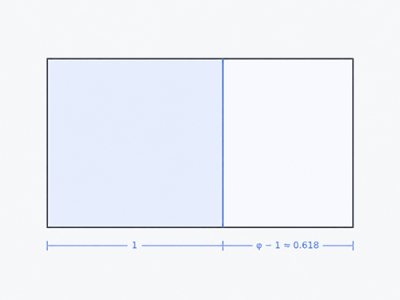
Two useful proportions follow from the same relationship:
1 / φ ≈ 0.6180339887 (approximately 61.8% of the total length)
1 / φ² ≈ 0.3819660113 (approximately 38.2% of the total length)
A golden division is therefore located about 61.8% of the way along a line from one end, or 38.2% from the other. Reversing the direction gives a second, symmetrical reference position. These are not arbitrary design percentages. Both follow from the same mathematical definition [1, 2].
Golden-ratio lines on the picture plane
To use the golden ratio in a rectangular or square picture, the width W and height H are divided independently. Vertical and horizontal guide lines are drawn at the corresponding positions.
- Vertical lines: x = 0.381966 × W and x = 0.618034 × W.
- Horizontal lines: y = 0.381966 × H and y = 0.618034 × H.
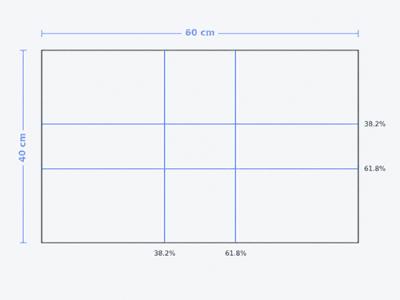
On a 60 × 40 cm canvas, for example, the vertical lines fall approximately 22.92 and 37.08 cm from the left edge. The horizontal lines fall 15.28 and 24.72 cm from the top.
The four intersections offer possible reference positions, while the lines divide the picture into unequal regions. The central band occupies about 23.6% of the corresponding dimension, with outer bands of approximately 38.2% each.
There is an important distinction: a 60 × 40 cm canvas has an aspect ratio of 1.5 rather than φ. Golden-ratio divisions can be drawn on any canvas format, but drawing those lines does not turn the whole canvas into a golden rectangle.
Golden division, golden rectangle, and phi grid
These related concepts do not mean the same thing.
Golden division describes the ratio used to split a line. In painting it is often represented by two vertical and two horizontal guides marking 38.2% and 61.8% of the frame dimensions.
A golden rectangle has a longer-to-shorter side ratio of φ:1. If its shorter side is 50 cm, its longer side is about 80.9 cm. Removing a square from a golden rectangle leaves a smaller rectangle with the same aspect ratio [1, 2].
A phi grid can be produced by repeating or extending divisions derived from the golden ratio. Different composition-analysis systems may use different numbers of lines or different constructions, so the exact grid must be specified before interpreting it. A more detailed phi grid deserves its own article.
The golden spiral is another mathematical concept, related to a particular logarithmic spiral. Popular diagrams often approximate it with quarter-circle arcs inside golden rectangles. Those circular arcs and the exact logarithmic curve are not identical. This distinction also deserves a separate discussion.
Golden-ratio guides, golden rectangles, and spirals should therefore not be treated as interchangeable names for one diagram.
Historical background: from Euclid to the Renaissance
The mathematical relationship was studied long before the modern name golden ratio became common. In Euclid’s Elements, the division is described as a line cut in extreme and mean ratio. The definition appears in Book VI, Definition 3. Related constructions occur in Book II, Proposition 11, and Book VI, Proposition 30 [1, 2].
In ancient geometry the ratio was important in the construction of a regular pentagon and certain regular solids. This establishes its mathematical significance. It does not, by itself, establish that ancient painters and architects universally regarded it as a mandatory formula for beauty.
A major Renaissance source is Luca Pacioli’s Divina proportione, published in Venice in 1509. Leonardo da Vinci contributed illustrations of geometrical solids to the book. This is a documented example of collaboration between mathematical study and artistic representation [3].
Yet Leonardo’s contribution to Pacioli’s book does not demonstrate that a golden-ratio grid was deliberately used in every painting by Leonardo. Claims about a specific painting’s intended structure need independent historical evidence.
The phrase golden section is also relatively modern. Historical scholarship traces its earliest known use in German mathematical writing to the first half of the nineteenth century, not to an ancient term for artistic beauty [2].
What to know about popular myths
Golden rectangles are often superimposed on the Parthenon, the Mona Lisa, ancient buildings, and other celebrated works. A visually convincing overlay is not, by itself, evidence of the creator’s intention.
For an overlay to count as a meaningful argument, the analysis must identify exactly which edges and points are measured, how the image was cropped, what tolerance is allowed, and whether independent evidence supports the proposed construction.
When a rectangle can be moved, resized, or fitted to a different crop without clear restrictions, similar-looking diagrams can be made to fit many images. Such flexibility does not establish that the artist planned the work around that ratio.
In a 1992 article, mathematician George Markowsky examined a range of widely repeated misconceptions about golden-ratio claims in art, architecture, and aesthetics [4]. The safest approach to historical works is to distinguish documented methods from attractive retrospective interpretations.
Similar caution applies to the natural world. Some spirals, pentagonal structures, and botanical patterns have meaningful mathematical connections to the golden ratio. But not every shell outline or plant form follows the ratio exactly. Visual resemblance is not a measurement.
What aesthetic research actually suggests
Gustav Fechner’s nineteenth-century experiments are often cited among early attempts to study people’s preferences for rectangles of different proportions. Subsequent experiments have produced mixed results.
A 2013 review by Stephen E. Palmer, Karen B. Schloss, and Jonathan Sammartino concluded that, although some observers prefer proportions in the general vicinity of the golden rectangle, preferences vary considerably across individuals and contexts. The combined evidence does not support one universally optimal aspect ratio [5].
A 1976 experiment also found that choices among rectangles were affected by the range of shapes presented and by cues given to participants [6].
These findings must be interpreted carefully. Choosing among empty rectangles is not equivalent to judging a complex painting. A painting also contains subject matter, directional movement, value relationships, color, shapes, texture, and emotional content.
The defensible conclusion is not that the golden ratio is useless. It has a clear mathematical structure and may serve as a useful compositional tool. But there is no sound basis for claiming that it always makes an image more beautiful.
Practical applications in painting
Still life
In a still life, golden-ratio lines can help explore the placement of the main group of objects. A tall bottle, for instance, might be related to one vertical guide, while a bowl or fabric mass acts as a counterweight.
However, the centers of individual objects are not the only relevant features. The group’s overall silhouette, overlapping forms, cast shadows, and negative spaces may matter more than whether a bottle’s edge exactly meets a guide.
Landscape
In landscape painting, a horizontal golden-ratio division can be an initial reference when deciding how much of the frame to give to sky and land. The chosen motif and visual emphasis, however, should determine the final position of the horizon.
A large cloud mass, a dark forest silhouette, or a prominent foreground shape can change the balance of the image completely even while the horizon remains fixed.
Portraiture
In portrait painting, golden-ratio lines may help an artist consider the relation between figure and surrounding space, the overall placement of the head, or the height of a bust within the composition. They should not be treated as a universal diagram of facial anatomy.
The dimensions of eyes, nose, mouth, and head vary with the individual, viewpoint, and perspective. Forcing anatomy to match a predetermined number may reduce the likeness of a portrait.
When the golden ratio is not needed
Golden-ratio division is not a requirement when the artistic idea depends on strict symmetry, a clear central axis, repetition, a dramatic diagonal, or deliberately unstable balance.
Guide lines should not be treated as equally powerful compositional commands. Sometimes a strong center is exactly what is needed. At other times the artist deliberately disrupts the center. The golden ratio simply offers one more possible arrangement.
Object placement should also be distinguished from visual weight. A small dark patch may balance a much larger low-contrast shape. Arithmetic proportion alone cannot evaluate that relationship.
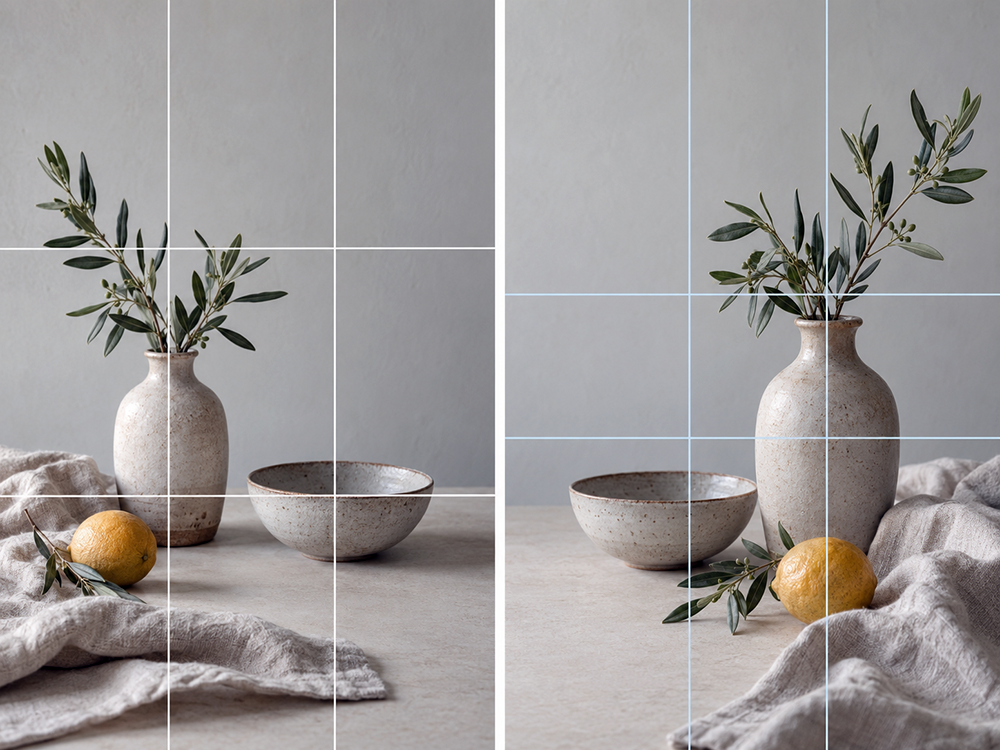
Practical exercise: three studies of one still life
Arrange a simple still life containing one tall object and two smaller ones. Keep the same paper format and produce three quick composition sketches using approximately the same viewpoint and lighting.
- Design the first sketch without a geometrical overlay. Concentrate on the overall silhouette and main value masses.
- For the second sketch, use the Rule of Thirds to explore the position of the principal object and distribution of the remaining space.
- In the third sketch, position the same objects with reference to golden-ratio lines at 38.2% and 61.8%. Do not try to force every object onto the grid.
Compare the sketches for clarity, silhouette, negative-space rhythm, visual weight, and the path of the viewer’s attention. Do not choose a winner based on mathematical accuracy. Choose the arrangement that best expresses the intended effect.
Conclusion
The golden ratio is a precise mathematical proportion and, in painting, one of many ways to organize a composition. Its guide lines can help an artist explore asymmetry and establish relationships between important parts of the picture.
The golden-ratio grid, golden rectangle, phi grid, and golden spiral are related but distinct constructions. They should not be collapsed into one universal scheme.
What matters is not whether a painting conforms to a preferred number but whether the chosen geometry helps solve an artistic problem.
Sources and further reading
[1] Euclid. Elements, Book VI, Definition 3 and Proposition 30; Book II, Proposition 11. Online edition of Euclid’s Elements.
[2] O’Connor, J. J., Robertson, E. F. The Golden Ratio. MacTutor History of Mathematics, University of St Andrews.
[3] Pacioli, Luca. Divina proportione (1509). University of Oklahoma Libraries, Galileo’s World exhibit.
[4] Markowsky, George. Misconceptions about the Golden Ratio. The College Mathematics Journal, 23(1), 2–19 (1992).
[5] Palmer, S. E., Schloss, K. B., Sammartino, J. Visual Aesthetics and Human Preference. Annual Review of Psychology, 64, 77–107 (2013).
[6] Piehl, J. The ‘Golden Section’: An Artifact of Stimulus Range and Demand Characteristics. Perceptual and Motor Skills, 43(1), 47–50 (1976).