

Fibonacci Spiral
Geometry, Movement, and Composition
The Fibonacci spiral is a familiar image in discussions of art and mathematics. It is constructed by joining circular arcs drawn inside squares whose side lengths follow the Fibonacci sequence. The result suggests a continuous turn from small to large forms and offers artists an accessible way to examine scale, direction, and the movement of attention across a picture [1–3].
Its popularity has also encouraged misleading claims. A Fibonacci spiral is not identical to a mathematically exact golden spiral, and a curve laid over a painting is not evidence that its artist deliberately used that construction. Understanding both the geometry and its limitations makes the guide more useful than treating it as a recipe for beauty.
From Fibonacci numbers to a spiral
The sequence begins 1, 1, 2, 3, 5, 8, 13, 21, …. Starting with the third term, each number equals the sum of the previous two. Draw two adjacent squares with side length 1. Attach a square of side 2 to the longer edge of the resulting rectangle, then attach squares of sides 3, 5, 8, and 13, turning around the growing arrangement. The seven squares fill a 13 × 21 rectangle [1, 2].
To draw the spiral, place one quarter-circle arc in each square. The circle’s center is a corner of that square, and its radius is the square’s side length. Choose the corners so that neighboring arcs meet end to end and follow the turn of the square arrangement. The seven radii are 1, 1, 2, 3, 5, 8, and 13 units. Each arc covers 90°, so the construction contains seven successive quarter-circle segments [1, 3].
The squares provide the straight-edged structure. The arcs provide the directional curve. Displaying both reveals where each change of scale takes place. Displaying the arcs alone emphasizes flow rather than the underlying rectangles.
Why the curve is only an approximation
A circle has constant curvature: along an arc of radius R, curvature equals 1/R. Consequently, each quarter circle of the Fibonacci construction has constant curvature within its own segment, but curvature changes when the next segment has a different radius. The arcs can join smoothly in direction while still exhibiting this change in curvature [3, 4].
An exact logarithmic spiral behaves differently. In polar coordinates it may be expressed as r(θ) = a · e^(bθ), where a is positive and b controls the rate of expansion. Its radius changes continuously with angle, and the angle between the tangent and the radial direction remains constant [4].
The golden spiral is a particular logarithmic spiral whose radius increases by the golden ratio φ = (1 + √5)/2 ≈ 1.618034 for each quarter turn. For an outward-growing spiral, its parameter is b = 2 ln(φ)/π ≈ 0.30635. These are properties of a mathematical curve, not of the separate quarter circles [4, 5].
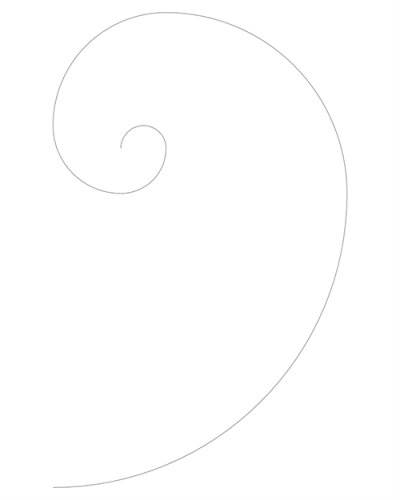
The ratios of consecutive Fibonacci numbers tend toward φ. This explains why the arrangement of larger Fibonacci squares increasingly resembles a golden-rectangle construction. Resemblance is not identity: the finite square pattern uses integer side lengths, and the composite arc curve does not acquire the exact curvature law of a logarithmic spiral [2–4].
How the spiral is constructed in REGIS ARS
The ARS Composition Guides provide Fibonacci Spiral and Fibonacci Spiral + Squares. Both use the same seven-square sequence with side lengths 1, 1, 2, 3, 5, 8, 13. The squares are attached successively to the right, bottom, left, and top, repeating this pattern as the construction expands.
For each square, the program creates a 90° circular arc, with its center at one of the square’s corners and its radius equal to the side. The combined geometry occupies a source rectangle measuring 13 × 21 units. It is fitted uniformly within 95% of the available canvas dimensions and centered. The circles are not stretched into ellipses, and the scale of each arc remains proportional to its square.
For example, on a 60 × 40 cm landscape canvas, the upright construction occupies approximately 23.52 × 38 cm. Empty margins at the left and right are expected: the spiral’s source rectangle is portrait-oriented, while the canvas is landscape-oriented. Enlarging the construction to fill the entire canvas independently in width and height would distort the geometry.
In Fibonacci Spiral, only the seven arcs are drawn. In Fibonacci Spiral + Squares, the outlines of the same seven squares accompany the arcs. Unlike the separate Golden Spiral guide, this Fibonacci construction does not use the Golden Spiral orientation control. It has a fixed arrangement derived from the sequence in the current ARS implementation.
These details describe the REGIS ARS implementation, not a universal rule prescribing the number of squares or their orientation. Other diagrams may extend the sequence or rotate or mirror the pattern [1, 3].
The spiral as a compositional tool
A spiral presents a possible path for the eye, moving through differently sized regions and changes in direction. Yet an overlay has no power to force a viewer’s gaze. Eye movement also depends on faces, contrast, edges, color, recognizability, and the artist’s choices. Treat the curve as a question posed to the composition: does this line support a movement that is already meaningful in the picture?
Still life: between the focal point and the surrounding group
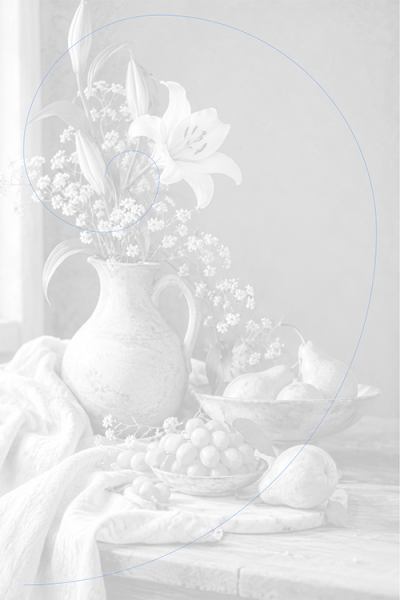
A useful experiment is to position the smallest turn near a significant junction in the object group, such as the point where two silhouettes overlap or where an important highlight meets a darker shape. The larger arcs may suggest how the gaze could move through the remaining objects and return toward the main emphasis.
Do not force a vase, fruit, or cast shadow to follow the curve exactly. A credible still life depends on the relationships of real volumes, negative spaces, value masses, and edges. A spiral may help investigate those relationships, but it cannot replace them.
Landscape: directing attention without imposing perspective
The expanding turn can be compared with the arrangement of a shoreline, a path, successive landforms, or cloud masses. When these forms already possess a curved direction, the overlay may help reveal their hierarchy. The spiral does not calculate perspective, specify a horizon, or determine the position of vanishing points. It is a compositional guide, not a projection system.
Portrait and figure: a tentative path, not an anatomical measure
A portrait may contain a curved progression between shoulder, head, hand, and surrounding background. The spiral can help compare this progression with the placement of the main focal detail. But neither Fibonacci numbers nor a golden spiral provide universal rules for locating facial features or measuring the human body. Observation of the particular sitter remains essential.
Abstract painting and design
In an abstract composition, the curve itself may become a structural gesture. A sequence of progressively larger fields can establish rhythm and variation. The artist may also interrupt or counteract the spiral to avoid an overly predictable result. Breaking the suggested movement can be as deliberate as following it.
History, visual culture, and evidence
The numerical sequence is associated with Leonardo of Pisa, whose Liber abaci appeared in 1202. Related counting rules were discussed in earlier Indian mathematical traditions. These facts concern the history of the numbers; they do not establish that a particular Fibonacci-arc diagram was used in Renaissance painting [6, 7].
Curved and spiral motifs are much older and occur in many cultures and natural forms. However, an ancient spiral ornament is not automatically a Fibonacci spiral. Its exact construction must be demonstrated rather than assumed. Similarly, a spiral superimposed on a famous artwork may look persuasive because the overlay can be resized, rotated, and repositioned. Visual coincidence is not documentation of an artist’s method [8].
It is equally misleading to say that every shell or plant grows according to the same golden spiral. Different growth processes produce different curves; some natural structures exhibit relationships to Fibonacci numbers, while others do not [8].
What aesthetic research does-and does not-show
In a 2024 experiment, psychologist Ronald Hübner compared visual preferences for a mathematically smooth golden spiral and a Fibonacci spiral assembled from circular segments. In that study, the golden spiral was preferred; the author connected this result to differences in curvature continuity. The paper also compared an Archimedean spiral with a segmented Dürer spiral [9].
This is not proof that paintings containing golden spirals are better paintings. The experiment compared specific displayed curves under controlled conditions, not finished still lifes, portraits, or landscapes. It does, however, show that the difference between a continuously changing curve and a succession of circular arcs is real and can be perceptually relevant.
Practical exercise: three versions of the same picture
- Draw the construction. On squared paper, build the seven squares of sides 1, 1, 2, 3, 5, 8, and 13. Add a quarter-circle to each square. Mark where one arc ends and the next begins, and compare the path with the square boundaries.
- Prepare a still-life thumbnail. Make a small composition without the spiral. Establish the main value masses and focal area before using any overlay.
- Compare three arrangements. Keep the original study. In a second sketch, test whether the curve reinforces the existing arrangement of objects. In a third, change the object positions to make their rhythm more clearly curved. Compare all three without treating geometric alignment as a score.
- Remove the guide. Does the composition still work without the visible spiral? If its hierarchy disappears, the drawing may need stronger pictorial relationships rather than more accurate geometry.
Conclusion
The Fibonacci spiral is a sequence of quarter-circle arcs related to Fibonacci squares. It is visually suggestive and mathematically understandable, but it is not the exact logarithmic golden spiral. In REGIS ARS, seven arcs and an optional seven-square construction make these relationships visible without distorting their proportions.
For an artist, the spiral is most useful as an exploratory framework: a way to think about rhythm, changes of scale, direction, and emphasis. The picture should remain convincing when the overlay is turned off. A successful composition is an artistic achievement, not a solved geometric puzzle.
Sources and further reading
[1] NRICH, University of Cambridge. Making Spirals. Construction activity.
[2] Beardon, Toni. Whirling Fibonacci Squares. NRICH, University of Cambridge, 2011.
[3] Nagy, M., Cowell, S. R., Beiu, V. On the Construction of 3D Fibonacci Spirals. Mathematics, 12(2), 201 (2024).
[4] Weisstein, Eric W. Logarithmic Spiral. Wolfram MathWorld.
[5] Weisstein, Eric W. Golden Spiral. Wolfram MathWorld.
[6] O’Connor, J. J., Robertson, E. F. Leonardo Pisano Fibonacci. MacTutor History of Mathematics, University of St Andrews.
[7] Singh, Parmanand. The so-called fibonacci numbers in ancient and medieval India. Historia Mathematica, 12(3), 229–244 (1985).
[8] Hart, Sarah. The Maths of Proportion in Art, Design and Nature. Gresham College, 2022.
[9] Hübner, Ronald. Golden spiral or Fibonacci spiral: Which is more beautiful and why? i-Perception, 15(2), 2024.