

Corner Diagonals
Structure, Balance, and Movement in Composition
Corner diagonals are among the simplest geometric guides an artist can draw across a picture. Two lines connect opposite corners of a rectangular or square format and cross at its exact centre. The construction looks like an X. It immediately reveals the central intersection and four triangular regions, while offering a way to investigate direction, scale, and the relationship between the subject and the frame.
The geometry is exact, but its artistic interpretation is not predetermined. The diagonals do not force the viewer’s eye to follow them, and their intersection is not automatically the best place for a focal point. Their value lies in making relationships visible and prompting useful compositional questions [1–3].
The geometric construction
Let the picture have width W and height H. Treat its upper-left corner as (0, 0), with x increasing to the right and y downward. Draw one segment from the upper-left corner to the lower-right corner and another from the upper-right corner to the lower-left corner:
- First diagonal: (0, 0) → (W, H).
- Second diagonal: (W, 0) → (0, H).
- Intersection: (W/2, H/2).
The two diagonals have the same length, √(W² + H²). Each diagonal cuts the rectangle into two equal-area triangles. Together the crossing lines create four triangles, each occupying one quarter of the canvas area. Equal area, however, does not mean identical shape: on a non-square rectangle the upper and lower triangles are generally differently shaped from the left and right triangles.
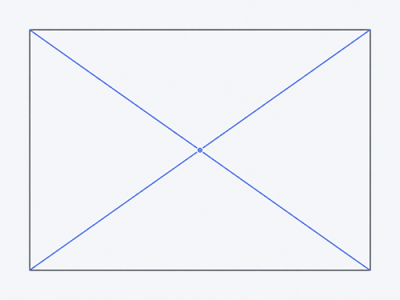
The angle each diagonal makes with the horizontal is arctan(H/W). Consequently, the diagonals are not generally at 45° and are not generally perpendicular. Both conditions occur for a square, but not for an ordinary rectangular canvas. The familiar X changes its appearance as the aspect ratio changes.
For a 60 × 40 cm landscape canvas, the lines run from (0, 0) to (60, 40) and from (60, 0) to (0, 40). They meet at (30, 20) cm; each is approximately 72.11 cm long, and each makes an angle of approximately 33.69° with the horizontal. On a portrait canvas of 40 × 60 cm, they become steeper, at approximately 56.31°.
These values describe the drawing precisely. They do not determine the relative importance of the four regions or assign them different expressive meanings.
What crossing diagonals reveal
Centre versus focal point
The intersection identifies the geometric centre, a useful reference when judging the placement of a figure, an object group, or an empty area. Yet the geometric centre should not be confused with the visual centre of attention. A tiny, strongly contrasted light shape near the edge may attract more attention than a large, low-contrast form at the crossing.
Try placing the principal object close to the intersection, then moving it a little away without changing the other elements. Notice how negative space and relationships with the frame change. The goal is not to hit the centre but to discover when centring or displacement supports the subject.
Diagonal direction and visual tension
Edges of objects, tilted axes, limbs, shadows, paths, and rows of marks can establish directional relationships. Diagonals are commonly associated with movement or instability when compared with horizontals and verticals. The J. Paul Getty Museum’s teaching material identifies this tendency, and the National Gallery contrasts dynamic arrangements built from intersecting diagonals with quieter compositions dominated by horizontal and vertical accents [1, 2].
This is a description of common perceptual effects, not a physical law. A diagonal can feel energetic, gentle, or almost invisible depending on contrast, surrounding shapes, rhythm, and subject matter. Two strong diagonal directions can create opposition, convergence, or a sense of compression. They can also compete and make an image unnecessarily busy.
Four sectors and visual weight
The X partitions the picture into upper, right, lower, and left triangular regions. Their areas are equal, but their visual weights need not be. A dark mass in a corner, a vivid colour, a face, or a sharply defined edge can dominate its region even when occupying little space.
Use the four sectors to compare, not to enforce, distribution. A convincing picture need not give every triangle the same amount of detail, light, or activity. In many paintings an unequal allocation is precisely what creates hierarchy. Rudolf Arnheim’s writing about perception and pictorial balance provides a broader framework for understanding why placement alone cannot explain visual balance [4].

Corner diagonals in painting practice
Still life: grouping volumes without drawing an artificial X
Arrange three to five objects and make a small monochrome study. Look for an existing diagonal in the silhouettes or the sequence of major forms. It may be the sloping edge of a cloth, a shadow, or an implied connection between two objects. Compare this tendency with one of the two corner diagonals.
Do not place every object directly on a line. The more important questions are whether the main group has a clear silhouette, how the objects overlap, and how the surrounding negative space supports the arrangement. The diagonal may confirm a useful direction or expose that several competing directions need simplifying.
Landscape: paths, slopes, and depth cues
Roads, riverbanks, receding roofs, mountain slopes, and cast shadows often contain diagonal elements. A corner-diagonal overlay can help an artist notice whether one movement is unusually dominant or whether opposing movements give the scene structure.
A composition diagonal is not the same as a perspective construction. A diagonal drawn across the picture frame does not automatically coincide with a line receding toward a vanishing point. Perspective depends on the geometry of objects and the viewpoint. A road may lead deep into the scene without matching either frame diagonal.
Portrait and figure painting: tilt and counterweight
A shoulder line, a bent arm, the alignment of head and torso, or the negative space around a turning figure may suggest a diagonal. Comparing these tendencies with the full-frame X can clarify whether the figure appears to lean, advance, or balance against its surroundings.
The grid is not an anatomical template. It cannot determine shoulder width, limb length, or head proportions. Keep drawing from observation; use the guide to consider the arrangement of the whole figure within the format.
Abstract composition: two directions are enough
For an abstract study, begin with two opposing directional tendencies instead of literal lines. Allow colour areas and edges to suggest one diagonal while smaller elements resist it along the other. Vary contrast and scale. A deliberate interruption can be more interesting than an exact X drawn in paint.
Art history: real diagonals, imaginary rulers
Diagonals have long been used in painting, but there is no verified historical claim that the specific two-line Corner Diagonals overlay was universally taught or systematically applied by old masters. Drawing the X over a finished picture is a modern analysis technique unless independent evidence demonstrates the artist’s intended procedure.
The National Gallery identifies intersecting diagonals as part of the dynamic composition of Peter Paul Rubens’s Minerva protects Pax from Mars (Peace and War), painted in 1629–30. The work is a valuable example because its movement also depends on interlocking figures, gestures, contrasts, and narrative. It is not evidence that Rubens physically plotted the exact corner-to-corner X before painting [2, 5].
In 1926, Wassily Kandinsky published Point and Line to Plane, an investigation of points, lines, the picture plane, and the tensions between visual elements. This work offers historical evidence of a modern artist treating line direction analytically. It should not be misrepresented as the origin or proof of the specific corner-diagonal construction used here [6].
Museum and university teaching resources describe directional lines as one way an artist may guide attention and create a sense of movement [1–3]. Those descriptions support examining diagonals as an artistic device. They do not demonstrate that a crossing-point formula predicts where every viewer will look.
How Corner Diagonals work in REGIS ARS
In the current ARS Composition Guides, Corner Diagonals consists of exactly two full-length canvas lines: upper left to lower right, and upper right to lower left. The construction automatically adapts to the actual width and height of the selected canvas. It does not add a frame of smaller squares, extra guides, or reciprocal perpendiculars.
It is important not to confuse three different options:
- Corner Diagonals: the two complete corner-to-corner segments making a single X.
- Diagonal Method: a separate four-line construction in ARS. Its line lengths are based on the smaller canvas dimension, so it is not simply another name for the full-frame X.
- Extended Diagonals: a more elaborate system containing the principal diagonals and additional lines connecting corners to opposite side midpoints.
All three can help study directional relationships, but their geometry is different. They deserve separate explanations rather than being presented as interchangeable traditional rules.
Common mistakes and limits
Treating the centre as a compulsory focal point. The crossing is a geometric fact, not an instruction to put a face, vase, or building there.
Assuming the triangles balance automatically. Equal geometric areas do not imply equal light, colour, texture, or visual weight.
Calling every sloping edge a corner diagonal. A tilted object may create a compositional direction without aligning with either full-frame diagonal. Its value need not depend on such alignment.
Confusing composition with perspective. The X is not a horizon finder and does not locate vanishing points.
Reading intention into a fitted overlay. An X drawn after a painting is completed cannot establish how the painting was planned.
Practical exercise: from X to actual composition
- Draw the geometry. Mark the opposite corners of a 60 × 40 cm rectangle and connect them. Find the midpoint without measuring it first; then verify the coordinates. Compare the angles with those of a square.
- Make a centred still life. Place the main object group near the crossing. Sketch large shapes, including cast shadows. Ignore the smaller details.
- Make an off-centre variation. Move the group so that its strongest visual direction approaches one diagonal, but let its focal area remain away from the intersection. Adjust the negative space.
- Create a counter-diagonal. Introduce a contrasting shape or shadow along the second direction. Decide whether it strengthens the composition or merely produces clutter.
- Hide the overlay. Compare the sketches without the X. Consider visual hierarchy, value masses, edges, balance, and what the subject is meant to communicate. Keep the best arrangement, not the one with the most line coincidences.
Conclusion
Corner diagonals are a precise and economical way to examine a picture’s structure. Their crossing defines its geometric centre, and their four triangular regions offer a useful map for comparing directional tendencies and visual weight. The X changes angle with the canvas proportions, but it never guarantees movement, focus, or aesthetic success.
The best use of this guide is diagnostic. Let it reveal relationships; do not let it replace observation, value organisation, colour, and artistic judgement. If the composition continues to work after the diagonal lines disappear, the guide has served its purpose.
Sources and further reading
[1] J. Paul Getty Museum. Understanding Formal Analysis: Elements of Art – Line. Educational resource.
[2] National Gallery, London. Composition. Glossary (static and dynamic composition examples).
[3] The Open University. Making Sense of Art History, section 7.3: The Use of Line.
[4] Rudolf Arnheim. Art and Visual Perception: A Psychology of the Creative Eye. Revised edition, 1974. University of California Press (2004 paperback edition).
[5] National Gallery, London. Peter Paul Rubens, Minerva protects Pax from Mars (‘Peace and War’), 1629–30, NG46.
[6] Solomon R. Guggenheim Museum. Wassily Kandinsky, Point and Line to Plane. First published 1926; English edition 1947.