

Dynamic Symmetry
Root Rectangles from √2 to √8
A diagonal can divide a picture, connect separate forms, or establish a direction of movement. But when its geometry is related to the exact proportions of a rectangle, it can also reveal a system of smaller, related areas. Dynamic symmetry is one way of studying these relationships. It combines the diagonals of a rectangle with lines perpendicular to them, creating a framework of directions, intersections, and reciprocal proportions.
The name is associated with the American artist and theorist Jay Hambidge (1867–1924). His ideas influenced twentieth-century discussions of artistic proportion, although some of his historical claims remain disputed. For a practicing artist, the most useful distinction is simple: the construction is mathematically precise; using it well is an artistic decision.
This guide examines seven related formats, from √2 to √8, together rather than treating each one as an unrelated method. They share a construction principle but produce different subdivisions and visual rhythms.
What is a root rectangle?
A root rectangle has a longer-to-shorter side ratio of √n : 1, where n is a positive integer. A √2 rectangle, for example, is about 1.414 times as long as it is high; a √5 rectangle is about 2.236 times as long. The root designation refers to the ratio, not to the number of objects or triangles in an artwork.
The sequence can be constructed with a straightedge and compass. The diagonal of a unit square measures √2. The diagonal of a right triangle with legs 1 and √2 measures √3; continuing with legs 1 and √3 gives √4, and so on. The companion article, Root Construction: √2–√8, explains the resulting rectangles and their repeated subdivisions in detail.
The ratios are not interchangeable. In particular, √5 is not the golden ratio: √5 ≈ 2.236, while φ = (1 + √5)/2 ≈ 1.618. The numbers are related, but a √5 framework is not a golden-section grid.
How the dynamic-symmetry framework is constructed
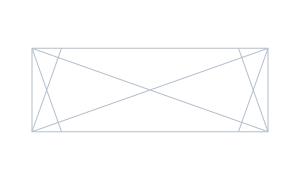
Begin with a rectangle of width W and height H, where W/H = √n. Draw its four edges and the two complete diagonals joining opposite corners. From each corner, construct an auxiliary line perpendicular to the opposite main diagonal and extend it to the boundary of the rectangle. This gives a framework of ten straight segments: four edges, two main diagonals, and four perpendiculars.
In the horizontal rectangle, the auxiliary lines meet the upper or lower long edge at points located one-nth of the width from the nearer side. This follows directly from the geometry:
H²/W = W/n, because W² = nH².
The corresponding end strip has dimensions W/n × H. Rotate it through 90° and its aspect ratio is again √n : 1; its area is exactly 1/n of the original rectangle. Such a smaller, similar area is called a reciprocal rectangle. This explains the underlying relationships without turning the guide into a compulsory placement scheme.
The main diagonals intersect at the center. The auxiliary lines create further intersections. Those points are construction results, not scientifically established locations where every painting must place its focal point.
Dynamic symmetry should not be confused with mirror symmetry, perspective projection, the Rule of Thirds, or a general invitation to fill a picture with diagonal lines. It is a specific proportional framework, and it can support an asymmetrical composition just as readily as a symmetrical one.
How REGIS ARS fits the framework to a canvas
REGIS ARS preserves each root ratio. It places the largest centered rectangle of the selected proportion inside the canvas, then draws the ten-segment framework within that rectangle. It does not stretch a √n rectangle to fill an unrelated format. Areas outside the fitted rectangle remain part of the artwork even though the guide does not cover them.
For example, on a 60 × 40 cm landscape canvas, a √2 rectangle fits at approximately 56.57 × 40 cm, leaving margins of about 1.72 cm on each side. For √3 to √8, the fitted rectangle uses the full 60 cm width, with equal unused bands above and below. A portrait canvas uses the corresponding rotated construction.
These details matter when preparing an accurate illustration. If an overlay is stretched, its diagonals and reciprocal divisions no longer represent the stated root proportion.
The seven root frameworks
The table shows the longer-to-shorter ratio, the reciprocal division point measured from either end of the fitted rectangle, and the approximate dimensions of that rectangle on a 60 × 40 cm canvas.
| Guide | Long/short ratio | Reciprocal point | Fitted rectangle (cm) |
|---|---|---|---|
| √2 | 1.4142 | 1/2 = 50% | 56.57 × 40.00 |
| √3 | 1.7321 | 1/3 ≈ 33.33% | 60.00 × 34.64 |
| √4 | 2.0 | 1/4 = 25% | 60.00 × 30.00 |
| √5 | 2.2361 | 1/5 = 20% | 60.00 × 26.83 |
| √6 | 2.4495 | 1/6 ≈ 16.67% | 60.00 × 24.49 |
| √7 | 2.6458 | 1/7 ≈ 14.29% | 60.00 × 22.68 |
| √8 | 2.8284 | 1/8 = 12.5% | 60.00 × 21.21 |
The percentages refer to the fitted root rectangle, not necessarily to the entire canvas. They describe where the perpendiculars meet its long edges; they are not independent vertical grid lines.
√2 – close relationships and opposing directions
The √2 rectangle is relatively compact. Its auxiliary lines connect each corner to the midpoint of the opposite long edge, creating clear opposing diagonal directions. This is useful for exploring a dominant group against an open area, or a figure whose silhouette interacts with the surrounding space.
A special property of √2 is that bisecting the rectangle along its long dimension produces two smaller, rotated √2 rectangles. The same principle underlies the approximate proportions of ISO A-series paper. That is a useful example of geometric self-similarity, not an artistic rule about paper sizes.
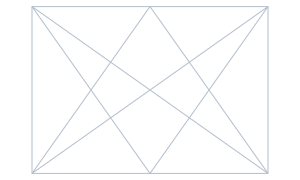
√3 – a three-part relationship
A √3 rectangle is wider. Its main diagonals lie at 30° to the horizontal in a landscape orientation, while the auxiliary perpendiculars reach the long edges at one-third and two-thirds of the fitted width. The resulting structure contains triangular and reciprocal relationships, but it is not a conventional Rule of Thirds grid.
Consider a landscape with a strong headland and a distant counterweight, or a portrait with space in the direction of the sitter’s gaze. The framework can help assess the relation between these areas without prescribing either the horizon or the position of an eye.
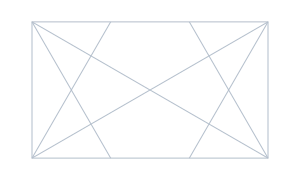
√4 – the double-square rectangle
Here √4 = 2, so the basic rectangle is exactly 2:1, or two adjacent squares. Unlike √2, √3, and √5, this proportion is rational. The dynamic framework nevertheless adds more than a dividing line between the squares: its diagonal perpendiculars establish quarter-width reciprocal relationships.
The format may suit an architectural arrangement, a pair of contrasting groups, or a long horizontal scene. The two halves need not receive equal visual weight. The squared structure is a starting point for comparisons, not a requirement for strict bilateral symmetry.
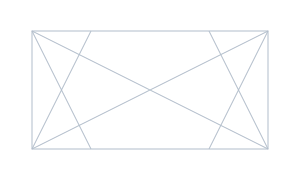
√5 – a connection to, but not an identity with, the golden ratio
A √5 rectangle is more elongated, and its reciprocal strips occupy one-fifth of its area. The perpendiculars reach the long edges at 20% and 80%. The same square root occurs in the formula for φ, but a √5 rectangle and a golden rectangle are distinct shapes.
This guide is especially interesting for a long sequence of forms-for example, the relationships among a leading figure, a secondary figure, and the space between them. Use the diagonal framework to compare movement and pauses rather than to locate objects mechanically at every intersection.
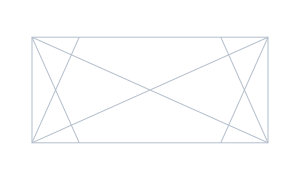
√6 – six-part reciprocal proportions
At √6, the fitted rectangle becomes noticeably wider and shallower. Its reciprocal positions lie at approximately 16.67% and 83.33% of its long edge. The main diagonals are less steep; their perpendiculars create relatively narrow side areas.
Such a framework can help analyze a broad scene or a horizontally extended group. It should not encourage the artist to compress the subject merely to fit the guide: the uncovered bands of the original canvas may still play an important compositional role.

√7 – a narrow reciprocal area
The √7 system places reciprocal points at approximately 14.29% and 85.71%. Its narrow side areas can be compared with a broad central field. The framework offers a different scale of subdivision from √6, although the underlying diagonal-and-perpendicular rule is unchanged.
For a composition with several groups, this can be a useful way to assess a narrow accent against a larger quiet mass. It does not mean that 1/7 is a universally preferred position or that historical artists used this exact overlay.
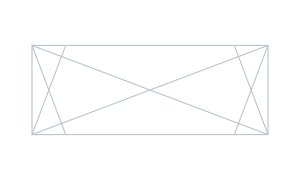
√8 – an elongated rectangle with a √2 connection
√8 = 2√2 ≈ 2.8284. Its reciprocal points are at 12.5% and 87.5%, and its main diagonals are relatively shallow. There is an additional geometrical relationship: dividing the rectangle into two equal-width halves produces two horizontal √2 rectangles. This links two formats in the family without making their internal dynamic-symmetry frameworks identical.
The elongated shape can help examine a composition built from distant groups, repeated accents, or a broad sweep of negative space. Even here, geometry is a means of comparison rather than a substitute for observing the picture as a whole.
Using the guide without forcing the image
A practical method is to start with the picture before showing the full framework. Identify the principal value masses, the main subject, and the balance of occupied and empty space. Then switch on the selected dynamic-symmetry guide and ask a limited set of questions:
- Does an important silhouette already echo one of the diagonal directions?
- Can a supporting group clarify a movement or counter-movement?
- Are some intersections useful for comparing distances, without becoming compulsory focal points?
- Do the visible margins outside the fitted rectangle strengthen or weaken the arrangement?
- Does the image still work when the overlay is hidden?
A tree line need not be ruler-straight, and a shoulder need not precisely follow an auxiliary line. Visual weight depends on value, contrast, color, edge definition, detail, and recognition, not solely on dimensions. A small dark accent can dominate a much larger pale area.
The guide also does not replace linear perspective: construction diagonals and vanishing-point geometry solve different problems. Nor does it determine anatomy or the correct level of a horizon.

Practical exercise: one subject, three root frameworks
Choose a simple subject – a still life, a street scene, or a figure in an interior – and work on the same 60 × 40 cm canvas. Make four small value studies:
- Without a guide. Organize the dominant and secondary masses by observation.
- With √2. Test the more compact diagonal relationships. Remember that the fitted rectangle leaves narrow side margins.
- With √5 or √6. Compare the wider construction. Let the picture cross guide boundaries naturally.
- With the guides hidden. Adjust the strongest version for clarity, rhythm, and emphasis.
For a second experiment, compare √3 and √4, or √7 and √8. The point is not to prove which root is “best”; it is to discover which structure helps the particular image and why. Assess the results at thumbnail size, where a complicated grid cannot disguise weak value organization.
Historical context and limitations
Hambidge’s Dynamic Symmetry: The Greek Vase (1920) and The Elements of Dynamic Symmetry (1926) developed systems of root rectangles, reciprocal relationships, and geometric analysis. Later authors, including Rachel Fletcher, examined their constructions as usable design geometry. The broad idea is historically influential, but fitting a grid to an ancient artwork does not demonstrate that its maker used that exact grid. Criticism of Hambidge’s interpretations appeared during his own lifetime.
It is also important to distinguish the historical system from the specific software overlays presented here. The ten-segment implementation for √2–√8 is a consistent REGIS ARS construction; it should not be presented as seven independently documented ancient artistic methods.
Conclusion
Dynamic symmetry offers a family of related rectangles and a consistent way of examining diagonals, perpendiculars, and reciprocal areas. Moving from √2 to √8 changes the format and the positions of its internal intersections, but not the central principle: geometry helps us question the arrangement; it does not make the final artistic decision.
For the matching subdivision grids, see Root Construction: √2–√8.
Sources and further reading
1. Hambidge, Jay. Dynamic Symmetry: The Greek Vase. Yale University Press, 1920.
2. Hambidge, Jay. The Elements of Dynamic Symmetry. Brentano’s, 1926.
3. Fletcher, Rachel. Dynamic Root Rectangles. Part One: The Fundamentals. Nexus Network Journal 9(2), 2007, pp. 327–361.
4. Fletcher, Rachel. Dynamic Root Rectangles Part Two: The Root-Two Rectangle and Design Applications. Nexus Network Journal 10(1), 2008, pp. 149–178.
5. Blake, Edwin M. Dynamic Symmetry – A Criticism. The Art Bulletin 3(3), 1921, pp. 107–127.
6. ISO. ISO 216:2007: Writing Paper and Certain Classes of Printed Matter – Trimmed Sizes.