

Golden Triangle
Diagonals, Perpendiculars and Compositional Direction
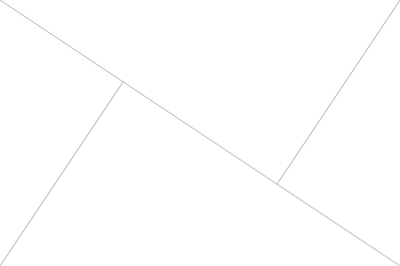
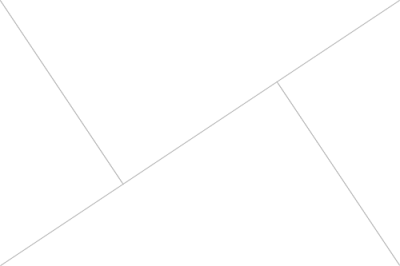
The Golden Triangle is a compositional guide that divides a rectangular picture into four triangular regions. It begins with one corner-to-corner diagonal. From each of the other two corners, a shorter line is drawn perpendicular to the main diagonal. The result is a clear directional framework that can help an artist compare arrangements, group large shapes and explore alternatives to an upright grid.
The familiar name requires a qualification. The Golden Triangle composition guide is not the same geometric object as the golden triangle of mathematics. The latter is a particular isosceles triangle with angles of 36°, 72° and 72°. The compositional framework described here produces right triangles, and its construction does not use the golden ratio φ. The distinction is essential if we want to discuss practical tools without repeating attractive but misleading claims.
Construction: three lines and four triangular regions
Let a picture have width W and height H. Define the top-left corner as A = (0, 0), the top-right as B = (W, 0), the bottom-right as C = (W, H), and the bottom-left as D = (0, H). The x-axis increases to the right and the y-axis downward, as in image coordinates.
Orientation 1: diagonal descending to the right. Draw A–C. Next, draw a segment from B to the point P on A–C that is nearest to B, and a segment from D to its nearest point Q on A–C. Both short segments meet A–C at a right angle. Thus the guide consists of A–C, B–P and D–Q.
Orientation 2: diagonal ascending to the right. Draw D–B. From A and C, draw the perpendiculars to D–B. This yields the opposite orientation of the same framework.
The two orientations are alternatives, not six simultaneous lines. Each divides the frame into four triangles. Which one is more useful depends on the dominant movement, silhouettes and areas of the particular image. A clockwise or counterclockwise visual movement should be assessed in the painting itself, not inferred automatically from the direction of a hidden guideline.
Why the two short lines are perpendicular
A perpendicular is the shortest straight distance from a point to a line. Here the two unused corners are projected onto the selected diagonal, and their projections are the endpoints of the shorter segments. These are geometrically defined positions; they are not arbitrary intersections chosen by eye.
The main diagonal divides the rectangle into two right triangles. Each perpendicular is an altitude from the right-angle vertex to the hypotenuse of one of those triangles. A standard theorem of Euclidean geometry states that such an altitude divides a right triangle into two smaller right triangles similar to the original [3]. Consequently, all four regions in this compositional diagram are similar right triangles, although they do not all have the same area.
Their areas and angles depend on the aspect ratio of the frame. In a square, the construction forms 45°–45°–90° triangles. In a rectangular frame, the acute angles differ. At no stage does the construction automatically produce the 36°–72°–72° triangle associated with the golden ratio.
Exact coordinates: a reusable construction
For the A–C orientation, write S = W² + H². The two perpendicular feet on the main diagonal are:
- From B = (W, 0): P = (W³/S, W²H/S).
- From D = (0, H): Q = (WH²/S, H³/S).
These formulas come from the orthogonal projection of a point onto the line from A to C. They apply to any rectangular aspect ratio with positive width and height. To obtain the second orientation, reflect the construction across the vertical or horizontal centre line, or project A and C onto D–B directly.
Worked example: 60 × 40 cm. Here W = 60, H = 40 and S = 5,200 cm². For the descending diagonal A–C, the perpendicular from the top-right corner ends at approximately P = (41.54, 27.69) cm, while the one from the bottom-left ends at Q = (18.46, 12.31) cm. The complete segments are (0, 0)–(60, 40), (60, 0)–(41.54, 27.69), and (0, 40)–(18.46, 12.31).
For the opposite D–B orientation, the feet are approximately (18.46, 27.69) cm from the top-left corner and (41.54, 12.31) cm from the bottom-right. Again, the construction has exactly three segments. A small rounding discrepancy in a printed diagram is normal, but the mathematical points themselves are unambiguous.
Does a golden ratio appear anywhere?
In mathematics a golden triangle is an isosceles triangle with equal-side-to-base ratio φ = (1 + √5)/2 ≈ 1.618. Its apex angle is 36° and the base angles are 72° [2]. It is closely connected to pentagons and pentagrams. The term in photographic composition, however, names a different construction [1].
Even if a picture happens to have the proportions of a golden rectangle, its diagonal-and-perpendicular guide is made of right triangles. It does not turn into the mathematical golden triangle. A frame of another aspect ratio works equally well. No golden rectangle is required to apply this overlay.
Some descriptions use the word golden loosely to suggest a pleasing division or a kinship with other proportional systems. That language is not a geometric proof. Whenever the exact value of φ matters, it should be demonstrated from actual measured lengths rather than assumed from the title of the guide.
What this framework can help an artist examine
The longest line, the main diagonal, establishes a broad direction across the picture. The two perpendicular lines introduce counter-directions, dividing the frame into four zones of different positions and, for most rectangular formats, different sizes. An artist can ask how the edges of a still-life group, a figure’s gesture, or a landscape feature relate to these directions.
The framework may also suggest alternative locations for a strong visual accent: perhaps near a short line’s junction with the main diagonal, perhaps inside one of the larger triangular regions. Yet those junctions are not universally privileged focal points. A bright highlight or a face can dominate far from a geometric crossing, while an accurately aligned object can remain almost invisible if its value contrast is low.
A useful distinction is between visible directions and invisible guides. The edge of a table, a cast shadow, an arm or the bank of a river is actually present in the picture. A geometric diagonal is only a temporary analytic reference. If an alignment exists solely on the overlay, a viewer may not perceive it when the overlay is removed.
The best time to consult this guide is often after the artist has already established the broad subject grouping and value masses. It can then expose a questionable direction or reveal a stronger alternative without becoming a substitute for observation.

Practical use: still life, portrait and landscape
Still life: a dialogue between long and short directions
Consider a bottle, a bowl and a folded piece of cloth. Start with their actual silhouette, overlaps and values. Place the main group slightly away from the middle and look at the resulting negative spaces. Now try the Golden Triangle overlay in one orientation. The long edge of the cloth may echo the main diagonal while the bowl and bottle provide counterweights. The shorter perpendicular can be a useful comparison for a secondary shadow or supporting object.
Then reverse the orientation. Do not automatically move everything to fit the new geometry. Instead, compare whether a different grouping makes the principal object clearer, whether the dark mass becomes too fragmented, and whether the remaining empty space still feels intentional.
Portrait and figure: gesture before geometry
For a turned head and shoulders, the main diagonal can help compare the direction of the figure with the available space. One of the short lines might correspond broadly to an arm or an opposing fold of clothing. Nevertheless, correct anatomy, the head’s construction, expression and lighting take priority. Moving an eye to a geometric intersection is not a valid reason to distort the skull.
The guide may be particularly useful for comparing crops of a gestural figure study. A frontal, nearly symmetrical portrait, by contrast, may be better assessed with a central axis or another structure.
Landscape: broad movement without inventing perspective
A shoreline, hillside, road or shadow boundary may create a diagonal direction across the image. Golden Triangle lines can help evaluate how that movement relates to the edges of the frame and whether the landscape has room for quieter counter-areas. Try the opposite orientation before committing to a final crop.
The guide does not determine perspective. Vanishing points follow the geometry of represented three-dimensional space, while Golden Triangle intersections are defined solely by the picture rectangle. Any apparent coincidence is a feature of that particular picture, not a general law of projection.
Relationship to other guides
Corner Diagonals draw both complete corner-to-corner diagonals. They cross at the frame’s centre and form an X. The Golden Triangle uses only one complete diagonal and adds two perpendiculars. The resulting divisions are therefore different.
Diagonal Method in this series refers to the framework of four 45° segments beginning at the corners. It is defined by the angle of those segments, not by projecting corners onto one long diagonal.
Extended Diagonals are a denser network formed by connecting corners with selected side midpoints. They serve a different type of analysis, with many more crossings. Combining all these overlays at once can obscure rather than clarify the painting; choose one according to the question you are trying to answer.
History, terminology and evidence
The diagonal-and-perpendicular diagram is a recognizable contemporary photographic composition guide. Nikon’s teaching material presents golden triangles as one of several optional framing grids, with examples in food photography [1]. This is evidence that the term and diagram are used in modern visual education, not evidence that a particular Renaissance painter constructed the same pattern.
Diagonal composition in a broader sense has a long history in painting. The National Gallery in London discusses the dynamic effect of intersecting diagonals in Rubens’s Peace and War [4]. But describing diagonal organization in a finished work is not the same as demonstrating that the artist drew this exact three-line overlay. To establish a working method, we would need relevant sketches, technical examination, contemporary instructions or comparable documentation.
Aesthetic research also cautions against treating a single geometric scheme as a universal law. McManus, Stöver and Kim (2011) tested particular predictions about visual balance and found that some broad patterns did not survive more controlled comparisons [5]. Their study did not test the Golden Triangle framework. It therefore neither proves nor disproves its effectiveness; it simply illustrates why confident claims about guaranteed beauty deserve caution.
Practical exercise: the same subject, two orientations
Draw a small still life or a figure composition in a 60 × 40 cm proportional frame. Prepare three identical copies of the initial sketch and keep the lighting and values reasonably consistent.
- Sketch A: make the best composition you can without a geometric overlay. Establish the largest silhouettes and three major value masses.
- Sketch B: place the descending-diagonal Golden Triangle guide over the composition. Make no more than two deliberate changes to improve a directional relationship or a negative space.
- Sketch C: use the ascending-diagonal orientation. Again, limit yourself to two considered changes. Do not change the subject merely to hit an intersection.
Reduce all three drawings to thumbnail size and compare them without the guide. Which has the clearest hierarchy? Where does the eye go first? Has an object become awkwardly tangent to another? Does the new arrangement improve the picture even when you cannot see the geometric lines?
Repeat the comparison in a square frame. You will discover that the guide’s angles and the shapes of its regions change with the format. The exercise is successful even if the unaided sketch turns out to be the strongest. The goal is to train compositional judgment, not obedience to a diagram.
Conclusion
The Golden Triangle composition guide is a precise three-line construction: one full diagonal and two perpendiculars from the remaining corners. Its two orientations offer alternative directional frameworks and divide the image into four similar right triangles. The arrangement may be useful for examining major forms, counter-directions, accents and negative spaces.
Its name should not be mistaken for a mathematical property. The diagram does not require the golden ratio, and it is not the 36°–72°–72° golden triangle. As with any compositional overlay, its value comes from the decisions it helps the artist examine, not from the geometry alone. Use it, question it, then hide it and look at the painting.
Sources and further reading
[1] Nikon. 7 Composition Grids to Try for Better Food Photography. Modern examples of the golden triangles compositional overlay.
[2] Eric W. Weisstein. Golden Triangle. Wolfram MathWorld. Mathematical definition and 36°–72°–72° angles.
[3] Mathematics LibreTexts. Euclidean Geometry, section 4.1. Similarity of triangles obtained by drawing the altitude to the hypotenuse.
[4] The National Gallery, London. Composition (glossary). Example of dynamic diagonal composition in Rubens.
[5] McManus, I. C., Stöver, K., and Kim, D. (2011). Arnheim’s Gestalt Theory of Visual Balance: Examining the Compositional Structure of Art Photographs and Abstract Images. i-Perception 2(6), 615–647.