

Extended Diagonals
A Ten-Line Framework for Composition
A diagonal can connect distant parts of a picture, create a directional relationship or help a painter examine the placement of forms. The Extended Diagonals guide develops this simple idea into a denser geometric framework. It combines the two corner-to-corner diagonals of the picture with eight additional lines, each connecting a corner to the midpoint of a non-adjacent side.
The result is a symmetrical network of ten straight segments. It provides several directions against which an artist can compare object placement, silhouettes and the boundaries between value masses. It is an analytical aid, not a formula for successful painting. Its geometry is exact, but aesthetic judgments still depend on the actual picture.
The construction: ten lines, not a collection of 45° diagonals
Let the picture have width W and height H. Use the top-left corner as the origin (0, 0), with x increasing to the right and y downward. The side midpoints are (W/2, 0), (W, H/2), (W/2, H) and (0, H/2).
Begin with the two full diagonals of the picture:
- From the upper-left corner (0, 0) to the lower-right corner (W, H).
- From the upper-right corner (W, 0) to the lower-left corner (0, H).
- Next add two lines from each corner to the midpoints of the two sides that do not meet at that corner:
- Upper-left (0, 0) → right midpoint (W, H/2) and bottom midpoint (W/2, H).
- Upper-right (W, 0) → left midpoint (0, H/2) and bottom midpoint (W/2, H).
- Lower-left (0, H) → top midpoint (W/2, 0) and right midpoint (W, H/2).
- Lower-right (W, H) → top midpoint (W/2, 0) and left midpoint (0, H/2).
Altogether there are two main diagonals and eight additional segments. The network is symmetrical about the vertical and horizontal centre lines of the rectangle, although those centre lines are not drawn as part of this guide.
It is important not to confuse the name with an angle measurement. In a non-square rectangle, even the two full diagonals are not at 45°. The eight extra lines have two other sets of slopes. Unlike the four fixed 45° lines of the Diagonal Method, this framework is defined by connections between fixed fractional positions along the edges, not by a prescribed angle.
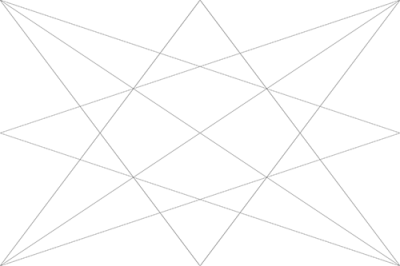
Worked example: a 60 × 40 cm painting
For a landscape canvas 60 cm wide and 40 cm high, the four midpoints are (30, 0), (60, 20), (30, 40) and (0, 20), measured in centimetres.
The two full diagonals run from (0, 0) to (60, 40) and from (60, 0) to (0, 40). The other eight lines are:
- (0, 0) → (60, 20) and (0, 0) → (30, 40).
- (60, 0) → (0, 20) and (60, 0) → (30, 40).
- (0, 40) → (30, 0) and (0, 40) → (60, 20).
- (60, 40) → (30, 0) and (60, 40) → (0, 20).
The angles are not interchangeable. Measured from the horizontal, the full diagonal rises or descends at approximately 33.7°. A line connecting the upper-left corner to the right midpoint has an angle of approximately 18.4°, while the line connecting that corner to the bottom midpoint makes approximately 53.1°. The other lines mirror these directions.
Some crossings are easy to locate precisely. The two complete diagonals cross at the canvas centre (30, 20). The lines from the two upper corners to the left and right midpoints cross at (30, 10), while their lower counterparts cross at (30, 30). None of these points has automatic compositional priority. Their usefulness depends on what is painted around them.
If the canvas is resized while retaining the same proportions, the entire pattern scales uniformly. If its aspect ratio changes, the endpoints remain at the same *fractions* of the sides but the line angles change. An accurate construction must therefore use the dimensions of the actual picture, not a visually similar overlay stretched arbitrarily from a different format.
What the network can reveal
The most useful aspect of Extended Diagonals is not the number of intersections. It is the availability of several directions within a single frame. The full diagonals cross the entire picture, while the extra lines link individual corners with midpoints on the other sides. Together they offer a way to investigate relationships between widely separated shapes.
For instance, a painter can compare a major silhouette with a diagonal direction, examine whether several edges echo one another, or ask whether a secondary element draws attention away from the principal subject. The overlay may also reveal a strong visual pathway that was not apparent in a small preliminary sketch.
However, a geometric line and a visible directional line are different things. A brushstroke, a limb or the edge of a tabletop actually appears in the picture. The guide remains invisible to the audience. A hidden alignment may be useful while designing, but it does not ensure that a viewer will follow that route.
The same distinction applies to the intersections. Ten lines naturally produce numerous crossings, making it relatively easy to find one close to almost any small detail in a busy painting. Finding such a match after the fact is not sufficient evidence of good composition. Nor does it show that a historic artist used this exact framework.

Practical use in different painting genres
Still life: group the objects before consulting the grid
Start by arranging the objects according to silhouette, overlap and value. For example, a bottle, a ceramic bowl and a folded cloth may form one large shape with a smaller secondary accent. First establish the relationship between the main light and dark masses. Then place the Extended Diagonals over the preliminary sketch.
Look for useful relationships rather than mandatory targets. Perhaps the upper contour of the bowl nearly follows one of the shallow diagonals, while the fold of the cloth suggests a steeper counter-direction. Try moving one supporting object a little and compare the overall balance. If the new arrangement strengthens the whole picture, keep it. If the change serves only the grid, discard it.
Portrait and figure: compare gestures and space
In portraiture, the head, shoulders, hands and surrounding negative space are more important than coincidental alignment with an invisible intersection. The network can nevertheless help compare the direction of the shoulders with the direction of an arm or the relationship between a face and an important hand gesture.
Do not distort anatomy to make a contour follow the guide. In particular, a diagonal through the eye does not become a substitute for establishing the skull, perspective of the head, lighting and expression. Treat the overlay as a temporary layer over an already plausible drawing.
Landscape and architecture: separate composition from perspective
A riverbank, path, roof or row of trees can establish pronounced diagonal movement. The Extended Diagonals may help assess how these larger directions relate to the edges of the picture. It is often more useful to compare several possible crops than to force a road or a roofline onto one particular segment.
In architecture, remember that perspective lines depend on the depicted three-dimensional geometry and vanishing points. Extended Diagonals are two-dimensional divisions of the frame. Their intersections are not perspective vanishing points, except by coincidence in a particular image.
Narrative painting: control relationships, not decorative geometry
A complex scene may contain several gestures, gazes and overlapping groups. The ten-line network can serve as a diagnostic overlay while comparing how these elements are distributed. It can also help identify whether the main action remains readable when the picture is reduced to a small thumbnail.
But when the overlay becomes too visually busy, hide it. Simplifying the composition to three or four value masses can be more informative than adding yet another crossing. A geometric guide earns its place only when it clarifies a specific artistic decision.
History: documented practice and modern overlays
Diagonal arrangements and directional lines are long-established subjects of visual analysis. The Open University’s art-history material discusses diagonal, vertical and horizontal directions as ways in which a composition may guide the viewer’s attention [1]. The National Gallery of Art similarly uses examples of visible diagonals to explain energetic and directional effects [2]. Neither source establishes a historical tradition of using this particular ten-line construction.
When discussing an old painting, it is useful to distinguish the visible organization of the finished work from evidence of the artist’s actual method. Preparatory sketches, written instructions, incised construction marks and technical examinations can reveal genuine working procedures. The Metropolitan Museum of Art describes the role of preparatory oil sketches in establishing a painting’s basic composition [3]. The National Gallery’s technical study of Raphael’s Garvagh Madonna reports ruled lines that bisect the composition horizontally and vertically, visible in infrared examination [4]. These are documented marks, but they are not evidence of an Extended Diagonals overlay.
Without equivalent documentation, we should not assert that Renaissance, Baroque or other historic painters deliberately used the ten-line framework. Its practical value today does not require inventing such a pedigree.
What research does-and does not-support
Studies of aesthetic balance caution against overconfidence in geometric rules. McManus, Stöver and Kim (2011) examined a specific interpretation of Rudolf Arnheim’s theory of visual balance. They observed some broad correlations between picture organization and selected axes, but more controlled within-image comparisons did not support the tested model [5]. Their experiments did not test Extended Diagonals, so they cannot prove or disprove this guide.
The sensible conclusion is limited but useful: a geometric network can structure a comparison between alternative layouts, yet no published result cited here shows that the ten-line overlay reliably makes a painting more attractive, balanced or historically authentic.
Practical exercise: test the overlay against the picture
Prepare a 60 × 40 cm proportional sketch of a still life with a dominant object and two supporting elements. Draw or print three identical copies.
- Version A: arrange the main shapes entirely by eye. Indicate only the three largest value masses and the basic silhouettes.
- Version B: add the ten-line overlay and move just one supporting shape to strengthen a directional relationship that seems useful.
- Version C: remove the overlay again, keep the principal shapes and change the arrangement in the opposite direction, deliberately ignoring the geometric crossings.
Compare the three at a small size, preferably in grayscale. Ask where the eye goes first, whether the main subject remains dominant, and whether the negative spaces feel intentional. Record which decisions improved the drawing and which merely produced coincidences with the grid.
Repeat the exercise with a square format. The altered slopes will reveal why this is a proportional construction, not a set of universally fixed 45° diagonals.
Conclusion
Extended Diagonals offers a precise, repeatable network of ten lines: two full frame diagonals and eight corner-to-midpoint connections. It is useful for exploring direction, relationships between distant elements and alternative placements during the design of a painting.
Its limits are equally important. The lines do not impose visual hierarchy, determine correct perspective or provide evidence that historical masters used the method. Strong composition still depends on value, form, colour, contrast, rhythm, negative space and artistic intention.
Use the guide to ask better questions about a painting, then turn it off and judge the result without the construction lines.
Sources and further reading
[1] The Open University. Making Sense of Art History, section 7.3, The Use of Line.
[2] National Gallery of Art, Washington. The Elements of Art: Line.
[3] Nicole Myers. The Aesthetic of the Sketch in Nineteenth-Century France. The Metropolitan Museum of Art, 2009.
[4] National Gallery, London. The Garvagh Madonna, technical examination and underdrawing.
[5] I. C. McManus, Katharina Stöver and Do Kim. Arnheim’s Gestalt Theory of Visual Balance: Examining the Compositional Structure of Art Photographs and Abstract Images. i-Perception, 2(6), 615–647, 2011.