

Rabatment + Diagonals
Squares, Directions and Compositional Relationships
Rabatment with diagonals extends the familiar division of a rectangle into two squares. Both diagonals are added to each square, revealing their centres, directional axes and, when the squares overlap, further intersections. For an artist, this offers a way to examine not only where objects are placed, but how silhouettes, negative spaces and visual directions relate to one another.
This construction is not a rule prescribing the location of a focal point. Nor is it a system of perspective. Its purpose is to provide a clear geometric reference that can be compared with the actual pictorial arrangement and discarded whenever it ceases to be useful.
Construction: two squares and four diagonals
Consider a horizontal picture of width W and height H, where W > H. Construct one square of side H against the left edge and another against the right edge. The left square occupies x = 0 to H; the right square occupies x = W – H to W. Their internal boundaries are the vertical lines x = H and x = W – H.
Draw both diagonals inside each square. Taking the upper-left corner of the picture as (0, 0), with x increasing to the right and y downward, the segments are:
- Left square: (0, 0) → (H, H) and (H, 0) → (0, H).
- Right square: (W – H, 0) → (W, H) and (W, 0) → (W – H, H).
- Internal square boundaries: (H, 0) → (H, H) and (W – H, 0) → (W – H, H).
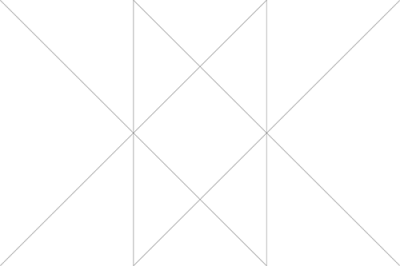
The construction therefore draws six line segments: two vertical and four diagonal. Because the diagonals belong to squares, they make angles of 45° with their horizontal sides. They are not diagonals across the entire rectangular canvas. A full-canvas diagonal in a 3:2 rectangle has a different angle, so the two structures should not be confused.
For a vertical picture (H > W), the construction rotates by 90°. The upper square occupies y = 0 to W, the lower square y = H – W to H, and their internal boundaries become horizontal. Each square again receives its two diagonals.
Worked example: a 60 × 40 cm picture
On a canvas 60 cm wide and 40 cm high, the rabatment boundaries lie at x = 20 cm and x = 40 cm. The 40 × 40 cm left square covers x = 0–40 cm; the right square covers x = 20–60 cm. Their central overlap is 20 cm wide.
The left-square diagonals connect (0, 0) to (40, 40), and (40, 0) to (0, 40). The right-square diagonals connect (20, 0) to (60, 40), and (60, 0) to (20, 40). The individual square centres are (20, 20) and (40, 20). These locations are mathematically determined, but there is no obligation to position a subject on either of them.
Diagonals belonging to different squares also cross at (30, 10) and (30, 30). Along with the two square centres, these points form a small diamond-shaped figure. Its centre is the picture centre, (30, 20). This is a genuine property of the 3:2 construction, not evidence of a special law of aesthetic preference.
The intersections exist because of how the lines have been drawn. Placing an object precisely on a crossing does not automatically improve the composition. The useful question is whether the location clarifies the intended relationships between large shapes or reinforces an expressive direction.
How the structure changes with the format
The relationship between the squares depends on the ratio r of the longer side to the shorter side.
- For 1 < r < 2, the squares overlap. Diagonals of different squares can intersect in the shared region. Nearer to a square format, the overlapping region is broader.
- For r = 2, the squares touch along their common central boundary. The two rabatment boundary lines coincide, leaving only one visible internal division; each square retains its own diagonals.
- For r > 2, the squares separate. A central rectangular gap remains, untouched by their four diagonal segments. This construction no longer extends diagonal lines across the full width of the picture.
For example, two 40 × 40 cm squares in an 80 × 40 cm picture meet at x = 40 cm. In a 100 × 40 cm panorama, they occupy x = 0–40 and x = 60–100 cm, leaving a 20 cm gap. That gap may provide a calm interval or undermine a composition in which important objects have been placed without regard to the frame.
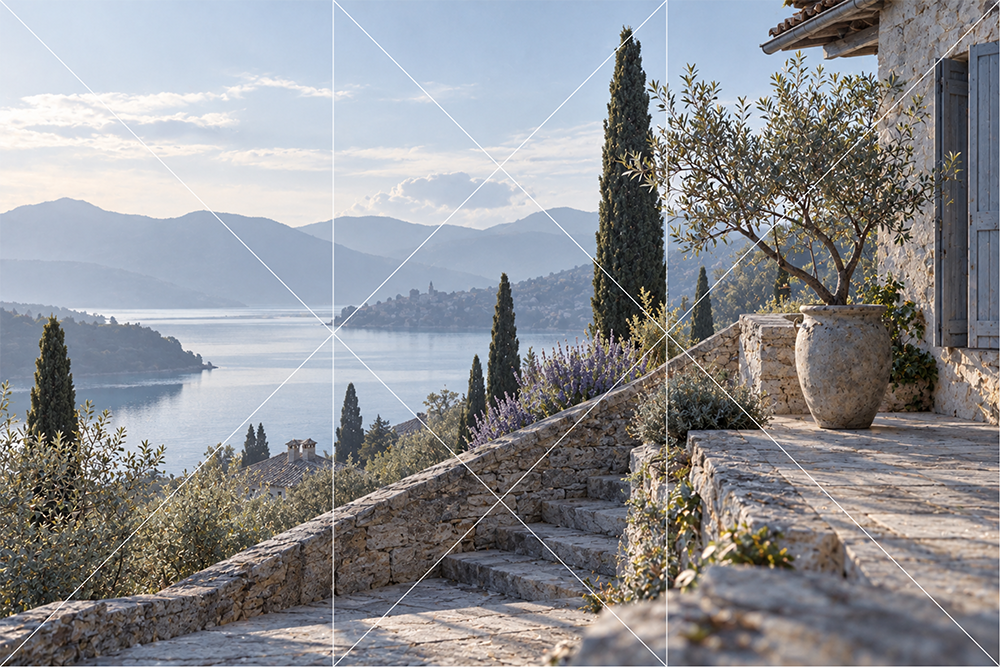
A square format is a special case. Mathematically, it is perfectly possible to draw the diagonals of one square. However, the current Rabatment + Diagonals guide in REGIS ARS displays no additional lines on a square canvas. This is a definition of the particular guide implemented in the application, not a mathematical prohibition.
What do the diagonals actually contribute?
Simple rabatment is particularly useful for considering the placement of broad groups. Adding the diagonals invites the artist to examine direction and relationships. Some questions worth asking are:
- Does a dominant contour broadly follow one of the square diagonals, or deliberately oppose it?
- Do large light and dark masses create an excessively strong directional pull?
- Are there meaningful triangular or diamond-like negative spaces between important shapes?
- Does the viewer’s attention move between visual accents when the guide is hidden?
The final question is the most important. A grid can look compelling on a monitor, but the finished painting communicates through actual contours, value, color and edge contrast. If a desired movement vanishes when the overlay disappears, the artist needs to establish it through visible pictorial elements rather than invisible lines.
Practical application: still life
Imagine a bottle, a bowl and a cloth hanging over the edge of a table. Before looking at the geometry, identify the largest light and dark masses, the silhouette of the entire group and the principal overlaps. Only then display the rabatment squares and their diagonals.
In one version, the bottle might stand near the centre of the left square while the lower shape of the bowl provides a counterweight to the right. The direction of the cloth can echo one diagonal without following it exactly. In another version, the whole group may move towards the central overlap but lose useful negative space. Compare both versions after hiding the lines.
Beware of forced coincidences. A vessel rim, fold of fabric or bottle axis aligned mechanically with a guide can make the arrangement feel more contrived rather than more natural. Accurate geometric correspondence is not an artistic goal in itself.
Portraiture, landscape and narrative painting
In a portrait, the diagonals can help compare the tilt of the head, direction of the shoulders and negative space surrounding the figure. They do not define anatomical proportions or prescribe the placement of the eyes. Expression, gaze, gesture and value relationships still determine the result.
In a landscape, compare the directions of a slope, path, river or cloud bank with the structure of the two squares. Such an exercise can reveal why one side of a composition feels more active than the other. However, these diagonals do not replace the horizon line or the geometry of perspective. A road converging towards a vanishing point belongs to perspective even if one of its edges coincides with a guide.
In figure and narrative painting, examine the gestures and intervals between figures. The turn of one body, the direction of another figure’s arm or the illuminated space between them may create a diagonal relationship similar to the overlay. Such relationships should arise from the depicted action, not from a requirement to fill a geometric scaffold.
Historical evidence and the limits of research
The construction of squares and their diagonals belongs to elementary geometry. Charles Bouleau’s The Painter’s Secret Geometry (1963) explores the role of the frame and historical interpretations of geometric composition [1]. This is a relevant background for understanding the method, but not evidence that our specific six-segment arrangement was a universal secret of earlier painters.
There is genuine technical evidence that historical artists used ruled construction lines. The National Gallery in London reports lines bisecting the picture horizontally and vertically beneath the paint of Raphael’s Garvagh Madonna [2]. These findings demonstrate that geometrical reference marks were sometimes part of a painter’s working process. They do not demonstrate the use of rabatment with diagonals in that painting.
Psychological studies also caution against treating geometry as a guaranteed predictor of beauty. McManus, Stöver and Kim (2011) examined predictions derived from Rudolf Arnheim’s account of pictorial balance. Several of their controlled comparisons did not support those predictions [3]. Their paper did not test this particular rabatment construction. It provides broader context for why the existence of a geometrical intersection is not sufficient evidence of aesthetic effectiveness.
Practical exercise: one subject, four studies
Choose a simple still life or landscape photograph. Keep the same 60 × 40 cm format and prepare four small studies of equal size.
- Without a guide. Arrange the broad forms and value masses by observation alone.
- Rabatment only. Add the two vertical boundaries. Try moving one important group.
- Rabatment + Diagonals. Add the four square diagonals and search for clearer directional relationships.
- Free correction. Hide every line and revise the composition without trying to preserve exact grid alignments.
Do not score the studies by the number of geometrical coincidences. Compare the intended focal point, negative space, dominant value contrast and movement between objects. A first or fourth study that works better than the highly structured version is a perfectly valid outcome.
Conclusion
Rabatment with diagonals is a logical extension of the two-square construction. It enables an artist to examine directional relationships and geometric crossings as well as divisions of the picture plane. Its appearance depends strongly on the aspect ratio: the squares may overlap, touch or separate altogether.
The guide can inform the arrangement of a still life, the gesture of a figure or the directions within a landscape. Yet a successful picture is built from visible shapes and relationships. The geometry is a means of asking better questions, not a substitute for the artist’s judgement.
Sources and further reading
[1] Bouleau, Charles. The Painter’s Secret Geometry: A Study of Composition in Art. Thames & Hudson, 1963. Bibliographic listing including publication details and contents.
[2] The National Gallery, London. “The Garvagh Madonna.” National Gallery Catalogues: Raphael, 2022. Technical study of the painting, including ruled marks beneath the paint. Not evidence for this specific rabatment scheme.
[3] McManus, I. C., Stöver, K., and Kim, D. “Arnheim’s Gestalt Theory of Visual Balance: Examining the Compositional Structure of Art Photographs and Abstract Images.” i-Perception, 2(6), 2011, pp. 615–647. A general study of perceptual balance, not a direct experiment on rabatment with diagonals.