

Harmonic Armature
Six Lines, Many Compositional Possibilities
A rectangle already contains a useful geometric fact: its diagonals intersect at the centre. Add perpendiculars from its corners, and a richer pattern emerges without dividing the surface into equally sized cells. This is the idea behind the Harmonic Armature guide in REGIS ARS. Its value is not that it reveals an invisible rule every painter must obey, but that it offers several related directions and intersections through which to examine a composition.
The word armature means a supporting framework. In art education it is applied to different geometric layouts, and there is no single universally standard diagram called the harmonic armature. The six-line REGIS ARS version is therefore described precisely here rather than confused with more elaborate armatures found in books or online.
The Geometric Construction
Begin with a rectangular picture plane of width W and height H. Draw both corner-to-corner diagonals. They intersect at (W/2, H/2) and divide the rectangle into four triangles of equal area, though the resulting triangles need not carry equal visual weight.
Next, take each corner in turn and construct a line perpendicular to the diagonal that does not pass through that corner. Extend that line in both directions, as necessary, until it meets the edges of the picture plane. This produces four additional straight lines.
The REGIS ARS guide consequently consists of six line objects: two full diagonals and four edge-clipped perpendiculars. It does not include the rectangular border as one of those six objects. The perpendiculars relate to the opposite diagonal, not to the nearest side of the canvas, and they are not 45-degree lines on every format.
You can construct the basic geometry with a ruler and set square. The diagonal directions are set by the picture’s aspect ratio. The angles of the perpendiculars follow from those directions: no golden ratio or specially chosen root rectangle is required.
Where Do the Key Intersections Come From?
A useful way to understand the construction is to examine the feet of the perpendiculars: the points where each additional line meets the diagonal to which it is perpendicular. These are geometrically determined, not chosen for their apparent importance in a painting.
For a rectangle measured from the top-left corner, put D = W² + H². On the diagonal running from top-left to bottom-right, the perpendicular from the top-right corner meets the diagonal at (W³/D, W²H/D). The perpendicular from the bottom-left corner meets it at (WH²/D, H³/D). Corresponding points occur by reflection on the other diagonal.
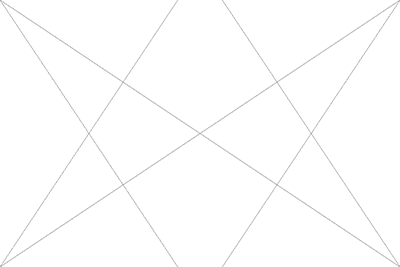
These formulas show why the crossing pattern changes with the aspect ratio. The scheme adapts automatically to a narrow or wide rectangle without imposing any one prescribed proportion on the canvas.
Worked Example: a 60 × 40 cm Canvas
The main diagonals connect (0, 0) to (60, 40) and (60, 0) to (0, 40). Their intersection is (30, 20) cm.
The four additional lines, clipped to the canvas, join these pairs of points:
- (60, 0) → (33.33, 40), perpendicular to the first diagonal.
- (0, 40) → (26.67, 0), also perpendicular to the first diagonal.
- (0, 0) → (26.67, 40), perpendicular to the second diagonal.
- (60, 40) → (33.33, 0), also perpendicular to the second diagonal.
Two feet of the perpendiculars on the first diagonal are approximately (41.54, 27.69) and (18.46, 12.31) cm. Their mirrored counterparts lie on the other diagonal. These are useful reference points, but they are not inherently the correct places for an eye, a face, a tree, or a highlight.
What happens on a square? When W = H, the perpendiculars coincide with the existing diagonals.REGIS ARS still creates six line objects, but visually they collapse into two distinct diagonals. This is a genuine consequence of the geometry, not a software error. It is also a reminder that the framework’s richness depends on the chosen format.

What Can a Painter Learn from the Armature?
Direction. The two main diagonals provide opposing directional tendencies. A long silhouette, a group of objects, or the boundary of a major value mass may reinforce one direction, while a smaller accent responds to another. The lines need not coincide with literal edges; they can be used to compare implied movement and structural relationships.
Intersection. Several lines cross within the frame. These crossings offer candidate positions to test, not guaranteed focal points. Their usefulness depends on the actual subject and the relationships between value, color, scale, and negative space.
Counterweight. The armature makes it easier to ask whether a visually dominant form near one side is balanced by the distribution of smaller or quieter forms elsewhere. A small dark object against a light background may counterbalance a much larger pale shape.
Unity across the frame. Because the diagonals and perpendiculars run across large portions of the picture plane, the guide can connect separated objects in a single compositional study. It is less useful when treated as an obligation to fill every small region.
Practical Uses in Painting
Still life. Start with the overall silhouette and the three largest value masses. Try placing the principal object near, but not necessarily on, one of the noncentral crossings. Arrange supporting objects to create a counter-direction. Hide the lines and ask whether the group still reads as one composition. A good result should survive the guide being removed.
Portraiture. Test how the tilt of the head, the shoulders, and the direction of the gaze relate to the major diagonals. An intersection may help you examine the location of an eye or a hand, but it does not provide anatomical measurements. The pose and the expression come first.
Landscape. Compare the strongest directional features: the edge of a field, a bank, a road, a tree group, or a cloud mass. A diagonal may help link near and distant elements. Unlike linear perspective, however, this guide does not calculate vanishing points or decide the horizon’s correct height.
Narrative and abstract painting. In a multi-figure arrangement, broad diagonals may help connect separated actions or groups. In abstraction, the framework can be used to establish and deliberately interrupt a directional rhythm. Neither application requires every important mark to fall on a line.
How Does It Differ from Other REGIS ARS Guides?
Corner Diagonals draws only the two corner-to-corner diagonals. Golden Triangle uses one of those diagonals plus two perpendicular segments that stop at that diagonal; REGIS ARS offers two orientations. Harmonic Armature combines the directions associated with both orientations and extends the perpendiculars all the way to the frame edges.
Dynamic Armature Grid begins with these same six lines and adds up to four horizontal and vertical lines through the relevant perpendicular-foot coordinates (some coincide in special formats). It is a denser analysis tool and will be covered separately. Neither armature is synonymous with the golden-ratio grid or a root-rectangle construction.
History: Geometry Is Not Proof of Artistic Intention
Artists have studied geometric structure for centuries, but the terminology and the diagrams vary across teaching traditions. In The Painter’s Secret Geometry (1963), Charles Bouleau surveyed geometric interpretations of compositions across art history [1]. Jay Hambidge developed influential diagonal and reciprocal constructions within his theory of dynamic symmetry in the early twentieth century [2, 3]. These are relevant historical contexts, not documentation that ARS’s exact six-line arrangement was a universally employed historical template.
Historical interpretation also deserves care. Edwin M. Blake criticised important claims of the dynamic-symmetry programme in 1921 [4]. A modern drawing laid over an old painting can produce many persuasive coincidences, especially if the analyst is free to choose among numerous lines, scales, and crops. A convincing line overlay is not, by itself, evidence of what the original painter planned.
Research on visual balance has found relationships between image structure, axes, and the placement of visual mass, but such work does not establish that a six-line armature increases aesthetic quality [5]. A modern artist may find the armature practically helpful without needing to claim a scientific law or a secret universal tradition. Contemporary explanations also show that different teachers use the term for different sets of lines [6].
Practical Exercise: Four Studies, One Motif
Choose three or four objects and prepare a series of small sketches at a fixed aspect ratio, for example 3:2.
- Without a guide. Draw the overall silhouette, dark masses, and largest empty spaces. Identify the principal visual interest.
- Only the two diagonals. Study the strongest directions and test whether the main group feels static, balanced, or unstable.
- All six armature lines. Try one alternative arrangement using a noncentral intersection or a reciprocal direction. Leave some crossings unused.
- Hide the construction. Make a final sketch by correcting awkward overlaps, lost value grouping, and any overly mechanical placements.
Compare the sketches at a small size. Which communicates the subject and visual hierarchy most clearly? The purpose is to discover whether this particular framework helps, not to make the subject obey the geometry.
Conclusion
Harmonic Armature in REGIS ARS is a precisely constructed network of two diagonals and four extended perpendiculars. It works with the actual proportions of the picture plane, not with a mandatory golden or root ratio. Its intersections can suggest useful questions about direction, rhythm, placement, and balance; none of them is automatically a visual centre of interest. The strongest use of the guide is to test compositional choices, then make the final decisions with your eyes.
Sources and Further Reading
1. Charles Bouleau. The Painter’s Secret Geometry: A Study of Composition in Art. Thames and Hudson, 1963.
2. Jay Hambidge. The Elements of Dynamic Symmetry. 1926; Dover edition, 1967.
3. J. Wilson. Dynamic Symmetry: A History and Analysis. Journal of Mathematics and the Arts 15(1), 2021, pp. 19–32.
4. Edwin M. Blake. Dynamic Symmetry-A Criticism. The Art Bulletin 3(3), 1921, pp. 107–127.
5. I. C. McManus, Katharina Stöver, Do Kim. Arnheim’s Gestalt Theory of Visual Balance. i-Perception 2(6), 2011, pp. 615–647.
6. Reed Enger. Advanced Composition Techniques. Obelisk Art History, 2019, updated 2022.