

Composition
Composition is the arrangement of visual elements within an artwork. It determines how shapes, lines, colors, values, and spaces relate to one another, creating a unified visual structure.
A thoughtful composition can make an image feel calm or dynamic, balanced or deliberately tense. It guides the viewer’s attention, establishes relationships between elements, and helps communicate the artist’s intention.
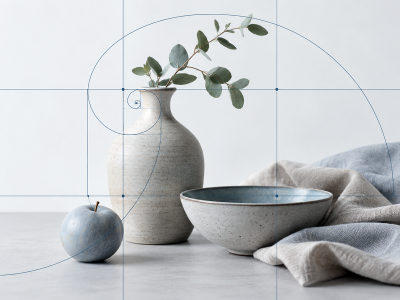
More Than Arranging Objects
Composition is not simply about deciding where to place the main subject. Every element contributes to the overall impression, including the areas that remain empty.
Several important principles influence how a composition is perceived:
- Visual balance concerns the distribution of visual weight throughout the image.
- Emphasis establishes areas of particular interest through contrast, size, placement, or other visual differences.
- Rhythm and movement guide the viewer’s eye through repeated shapes, directional lines, and relationships between elements.
- Proportion and space determine how objects relate to one another and to the boundaries of the picture.
These principles work together rather than independently. Changing the position, scale, or contrast of a single element can noticeably alter the character of the entire composition
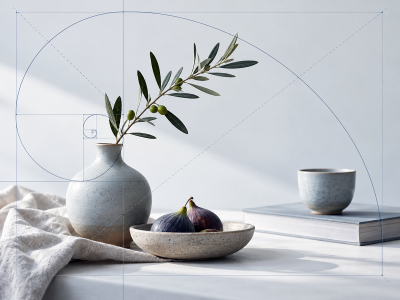
Seeing the Whole Before the Details
Compositional decisions often begin long before the final drawing or painting. Small preliminary sketches can help explore different arrangements, simplify complex scenes, and establish the relationships between major shapes.
An artist may adjust the framing, eliminate distracting details, change the balance of light and dark areas, or reconsider the position of the focal point.
The objective is not necessarily to achieve perfect symmetry or harmony. An effective composition may also rely on imbalance, tension, or unexpected relationships when these serve the artistic intention.
Principles, Not Rigid Rules
Over time, artists and theorists have developed numerous compositional systems, including the Rule of Thirds, Golden Ratio, diagonal constructions, and geometric armatures.
These systems provide useful ways to study, organize, and experiment with visual relationships. However, no mathematical construction guarantees a successful artwork.
Understanding compositional principles gives artists greater freedom to make deliberate choices rather than follow formulas mechanically.
The articles in this section explore individual composition methods, their geometric foundations, and their practical applications in drawing and painting.