

Rabatment
Finding the Squares Within a Rectangle
Rabatment of the rectangle is a way of examining a picture’s proportions by finding the two squares that can be constructed from its shorter side. For a horizontal painting, one square begins at the left edge and another at the right. In a vertical format, they begin at the top and bottom. Their inner boundaries offer two simple reference lines for considering subject placement, negative space and the relationship between the centre and edges of a composition.
Rabatment is not a formula for making a painting beautiful. It is a geometric observation about the frame, followed by an artistic choice about whether the resulting divisions are useful. Unlike the Rule of Thirds, its lines do not divide every canvas into the same proportional bands. Their positions depend on the aspect ratio of the picture. That difference is the key to understanding the method.
The basic construction
Imagine a horizontal rectangle with width W and height H, where W is greater than H. Starting at its left edge, measure a distance H along the top and bottom. Connect those two points with a vertical line. The area from the left edge to this line is a square of side H. Repeat from the right edge to construct a second square.
If the top-left corner of the picture is (0, 0), with x increasing to the right, the positions of the two interior boundaries are:
- Left square: x = H.
- Right square: x = W – H.
Both lines run from y = 0 to y = H. The formula is not an approximation. Each square is exactly as tall as it is wide.
For a vertical picture, H exceeds W. The procedure is turned through 90°. The upper and lower squares each have side W, and their horizontal boundaries lie at y = W and y = H – W. If the picture is square (W = H), the entire frame already forms a square; the construction adds no internal division.
What the term means. Rabatment comes from the language of folding or turning a length into another position. In elementary descriptions of the method, the short side is imagined as being turned onto the adjacent long side to mark the depth of the inscribed square. Nothing has to be physically folded. The squares can be drawn with a ruler or generated as an overlay.
A worked example: a 60 × 40 cm canvas
Take a landscape-format canvas 60 cm wide and 40 cm high. Its shorter side is 40 cm. The square starting on the left occupies x = 0-40 cm. The square starting on the right occupies x = 20-60 cm. Therefore, the two rabatment boundaries are vertical lines at x = 20 cm and x = 40 cm.
The middle 20 cm strip, from x = 20 to 40 cm, belongs to both squares. That overlap has an area of 20 × 40 = 800 cm². The two squares each occupy 1,600 cm², whereas the entire canvas has an area of 2,400 cm². There is no contradiction: the central region was counted twice when adding the areas of the two squares.
At a glance, the lines in this particular 3:2 format happen to fall at one-third and two-thirds of the width. That numerical coincidence often causes confusion. Rabatment is not another name for the Rule of Thirds. On a 60 × 45 cm canvas (4:3), rabatment lines are at x = 15 and 45 cm, or one-quarter and three-quarters of the width, whereas third lines remain at 20 and 40 cm.
The distinction matters when an artist changes the format. Rabatment follows the short-side length; a three-part grid follows fixed fractions of the full width and height.
When the two squares overlap, touch or separate
Let r be the ratio of the longer side to the shorter side. Three cases explain how the geometry changes:
- 1 < r < 2: the squares overlap in the middle. A 60 × 40 cm picture is in this group.
- r = 2: the inner boundaries coincide at the centre, so the two squares touch along one line. For an 80 × 40 cm canvas, that line lies at x = 40 cm.
- r > 2: the squares are separated by a central rectangular gap. In a 100 × 40 cm panorama, they occupy x = 0-40 and x = 60-100 cm, leaving the strip x = 40-60 cm between them.
These cases are not merely mathematical curiosities. The same rabatment overlay can suggest very different relationships in a near-square study, a conventional landscape format and a very wide panorama. There is no universal pair of focal points that works independently of the frame.
For a square canvas, no distinct inside boundaries are produced. The painter must seek compositional structure in the actual subject or use another guide.
What can the artist learn from the two squares?
The principal value of rabatment is not that it tells us where to put a focal point. It encourages us to see the canvas as two edge-anchored square fields and compare them with the image’s visible masses. An artist can ask whether the main group feels contained within one square, whether a quieter area counterbalances it, and whether a boundary passes through an important contour or visual accent.
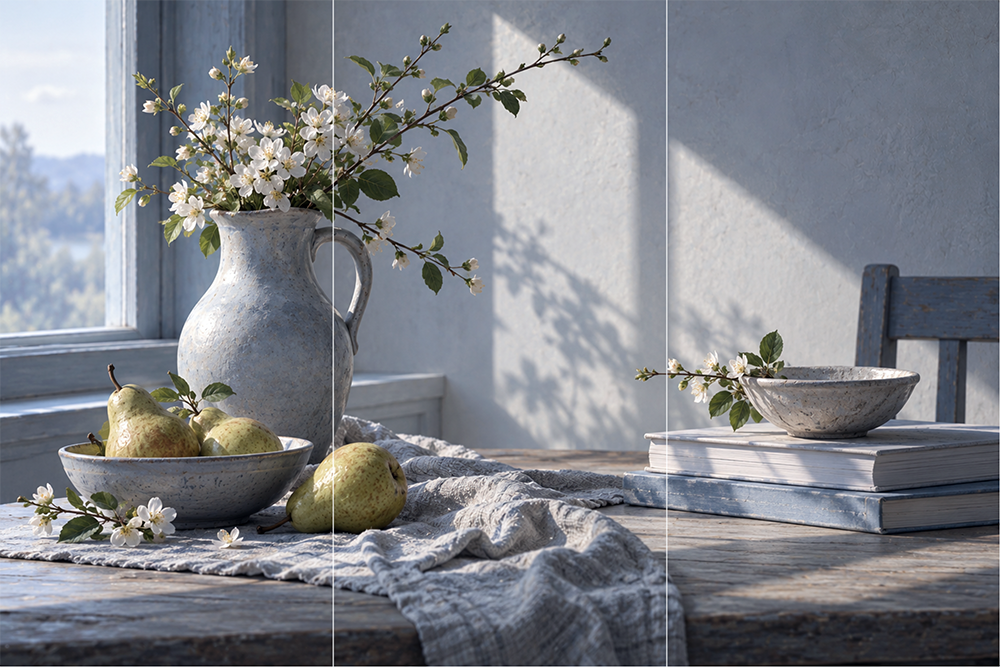
One possible arrangement places the dominant still-life group largely within the left square, with a subordinate object or extended cast shadow continuing into the right. Another places the main subject close to an inner boundary rather than wholly within a square. Neither arrangement is automatically better. What matters is the relationship between shapes, values and intended emphasis.
The boundaries may also be useful when looking for awkward tangencies. If a long vertical stem coincides with a rabatment line, is that alignment helping the structure, or does it make the composition feel artificially divided? A guideline should help formulate such questions rather than answer them by itself.
Visible structure and geometric overlay are different things. A viewer does not normally see the rabatment lines. If the painter wants to establish a clear rhythm or grouping, that effect must be carried by actual silhouettes, edges, tonal masses, colors and intervals between objects.
Applying rabatment to painting
Still life: placing a group rather than isolated objects
Arrange a bottle, a ceramic bowl and a small folded fabric. Before adding any guides, simplify the objects into two or three large value masses. Note the entire group’s silhouette and the spaces around it. Then overlay the two rabatment squares.
Try moving the whole group so that its principal mass sits broadly within one square and the fabric or cast shadow enters the second. Compare this with a version in which the bottle is near an inner boundary. Pay attention to the spacing between objects. If the overlaps, shadows or negative spaces become worse, abandon the geometric alignment. Rabatment should help refine an arrangement already based on observation.
Portrait: framing and direction of attention
In a vertical portrait, the upper and lower squares provide horizontal boundaries. These can help examine whether the head, shoulders and surrounding space occupy a convincing share of the format. A seated figure may extend through both squares, while the region of the face remains the centre of interest because of value contrast and expression.
There is no requirement to position the eyes on a rabatment line. Anatomical proportions, the gesture of the sitter and the amount of space in the direction of the gaze take precedence. A deliberate central or symmetrical portrait may have no need for rabatment at all.
Landscape: masses before the horizon
A horizontal landscape may contain a foreground bank, a tree group and distant architecture. The left and right squares provide a simple way to compare their relative spread and visual weight. The method can help evaluate whether an isolated tree feels detached from the rest of the scene or whether a prominent dark foreground mass needs a counterpart.
Rabatment does not prescribe the height of the horizon, the position of the vanishing point or the direction of perspective lines. These belong to different considerations. A rabatment boundary might coincide with a tree trunk or building edge in a particular painting, but that coincidence does not prove the picture was designed from the overlay.
Relation to other geometric guides
Rule of Thirds divides width and height into three equal parts, independently of aspect ratio. Rabatment derives its internal lines from the shorter side. In a 3:2 landscape they happen to share the two vertical positions, but generally they are different schemes.
Rabatment + Diagonals takes the same two squares and adds both corner-to-corner diagonals within each square. On a normal horizontal rectangular canvas this produces two square-boundary lines and four diagonal segments. It is a separate, more detailed REGIS ARS guide and will be addressed in its own article. Rabatment on its own contains no diagonals.
Dynamic Symmetry uses additional geometric ideas, including root rectangles, reciprocal diagonals and proportional subdivisions. A rebated square can be one element within more complex construction systems, but drawing two squares does not by itself establish that a work uses dynamic symmetry or the golden ratio.
Historical background: useful method, cautious claims
The geometrical operation of deriving a square from a rectangle is elementary and not attributable to a single known inventor. Geometric analyses of pictorial composition have a substantial literature. Charles Bouleau’s The Painter’s Secret Geometry: A Study of Composition in Art (1963) discusses frameworks used to analyse painting, including the role of the frame and historical geometric interpretations [2]. The method also appears in modern practical descriptions of composition [1, 3].
These sources establish that rabatment belongs to a tradition of compositional analysis. They do not automatically prove that a specific historical painter laid out a particular picture using two rabatment squares. Retrospective overlays can fit visible features by coincidence or selective placement. Strong historical evidence would require working drawings, measured preparatory marks, workshop instructions or related documentation.
Claims that the human brain instinctively completes the two squares, or that attention must be drawn to a specific rabatment line, should be treated as interpretations rather than universal psychological laws. Studies of pictorial balance show that viewers respond to many interacting variables; they do not identify the rabatment overlay as a guaranteed cause of aesthetic preference [4, 5].
Practical exercise: one arrangement, three formats
Choose a group of three or four objects with one clearly dominant object. Keep the lighting fixed. First, make three small outline-and-value sketches with formats of 60 × 40, 60 × 45 and 80 × 40 units. Use the same objects but adapt their placement and cropping to each frame.
- In each sketch, draw the rabatment boundaries lightly: 20 and 40 for 60 × 40, 15 and 45 for 60 × 45, and the shared centre line at 40 for 80 × 40.
- Try a version with the main mass inside one implied square and a second version with the main accent close to one boundary. Do not force every object onto a line.
- Remove or hide the guides. Compare the silhouettes, negative spaces and large dark-light relationships. Decide which arrangement works best without visible geometry.
Repeat the exercise with a vertical format if desired. A useful observation is not which drawing obeys the overlay most precisely, but which decisions improve clarity when the overlay disappears.
Conclusion
Rabatment offers a simple and exact way to discover two squares within a rectangular frame. Because those squares change their relationship as the aspect ratio changes, the guide is especially useful for thinking about format, grouping and negative space. It can reveal alternatives to automatic centring without dictating where a focal point must go.
Its limits are equally important. Rabatment does not calculate visual weight, determine perspective, establish historical authorship or guarantee beauty. The painting itself remains the test. Use the squares to ask better compositional questions, then judge the answers with the guide switched off.
Sources and further reading
[1] Garvey-Williams, Richard. “Mastering Composition: Principles and Rules”, part 2. Digital Camera, August 2025. Practical description of rabatment and its use in photography.
[2] Bouleau, Charles. The Painter’s Secret Geometry: A Study of Composition in Art. Thames and Hudson, 1963. Bibliographic record, WorldCat.
[3] Obelisk Art History. “Advanced Composition Techniques”. Contemporary practical discussion of rabatment; historical examples should be treated as analytical proposals, not documentary proof.
[4] McManus, I. C., Stöver, K., and Kim, D. “Arnheim’s Gestalt Theory of Visual Balance: Examining the Compositional Structure of Art Photographs and Abstract Images.” i-Perception 2(6), 2011, pp. 615–647. Not a direct test of rabatment.
[5] McManus, I. C., Edmondson, D., and Rodger, J. “Balance in Pictures.” British Journal of Psychology 76(3), 1985, pp. 311–324. Study of perceived pictorial balance, not a specific rabatment experiment.