

The Fibonacci Grid
Sequence and Compositional Rhythm
A Fibonacci grid is a geometric aid for studying composition in which the picture plane is divided using selected Fibonacci numbers. Unlike the Rule of Thirds, its divisions are not equal. The grid can be used to examine areas at different scales, the spacing between objects, the placement of visual accents, and the rhythm of a composition.
There is no single universally established Fibonacci grid that artists have used throughout history. Different designs may use different numbers from the sequence, their sums, or geometric constructions. The essential first step is to define the exact construction being discussed. This article examines the symmetrical grid implemented in REGIS ARS. It is distinct from Fibonacci squares and the Fibonacci spiral.
What is the Fibonacci sequence?
The Fibonacci sequence is commonly written as:
1, 1, 2, 3, 5, 8, 13, 21, 34, 55, …
Beginning with the third term, each number is the sum of the two preceding numbers: for example, 3 + 5 = 8 and 5 + 8 = 13. Formally, Fₙ = Fₙ₋₁ + Fₙ₋₂. The sequence can also be written starting with zero: 0, 1, 1, 2, 3, 5, and so on. Both notations express the same recurrence [1].
As the terms increase, the ratio of two consecutive Fibonacci numbers approaches the golden ratio, φ ≈ 1.618034. However, a grid assembled from a handful of small Fibonacci numbers is not automatically a golden-ratio grid. The sequence and the golden ratio are related mathematical concepts, not interchangeable names [1].
Constructing the grid examined here
The REGIS ARS Fibonacci Grid uses six terms from the sequence:
1 + 1 + 2 + 3 + 5 + 8 = 20
Their sum, 20, represents the full relative length of either picture dimension. The cumulative sums before the final term are 1, 2, 4, 7, and 12. Dividing each by 20 gives five initial positions: 5%, 10%, 20%, 35%, and 60%.
Each position is mirrored from the opposite edge. After sorting all distinct positions, the ten vertical guide positions measured from the left edge are:
5% · 10% · 20% · 35% · 40% · 60% · 65% · 80% · 90% · 95%
The same relative positions are used for ten horizontal guides measured from the top edge. The result is a symmetrical set of twenty lines.
For a picture of width W and height H, an individual coordinate can be expressed as x = p × W or y = p × H, where p is one of the percentages above expressed as a decimal fraction.
These positions define this particular compositional overlay. They are not an established historical law of artistic proportion. A different number of sequence terms or a different method of arranging them would produce a different grid.
How many regions are there?
Ten vertical lines produce eleven vertical bands, while ten horizontal lines produce eleven horizontal bands. Together, they divide the picture plane into 121 rectangular areas, with 100 internal line intersections.
The relative widths of the bands from one edge to the other, in percent, are:
5 · 5 · 10 · 15 · 5 · 20 · 5 · 15 · 10 · 5 · 5
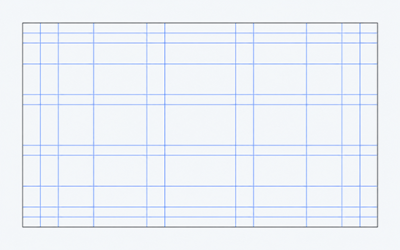
The central band occupies 20% of the dimension. Narrower and wider bands appear on either side. This arrangement offers a possible way to examine the relationship between small and large areas, but does not in itself create a focal point.
The boundaries of all 121 areas are not equally important to every picture. A dense grid may support analysis, but can just as easily obscure the larger organization. Pay attention only to the guides that help answer a meaningful compositional question.
Worked example: a 60 × 40 cm canvas
Consider a landscape-format canvas measuring 60 cm wide and 40 cm high. The vertical lines fall at the following distances from the left edge:
3 · 6 · 12 · 21 · 24 · 36 · 39 · 48 · 54 · 57 cm
The horizontal lines fall at the following distances from the top:
2 · 4 · 8 · 14 · 16 · 24 · 26 · 32 · 36 · 38 cm
Each value is obtained by multiplying the width or height by the corresponding proportion. The outer canvas does not have to have a Fibonacci-number aspect ratio. The overlay can be applied to any rectangle or square because the horizontal and vertical dimensions are divided independently. Using the grid does not change the proportions of the canvas itself.
Do not confuse these divisions with an arrangement of Fibonacci squares. That separate construction uses square sides equal to successive numbers in the sequence, forming a growing rectangle with its own changing aspect ratio.
How to examine a picture with the grid
1. Establish the overall composition first
Before enabling any overlay, identify the main light and dark masses, the overall silhouette of the subject group, and the intended emphasis. Twenty additional lines will not rescue a composition whose essential relationships are unclear without them.
2. Examine areas rather than all intersections
The central 20% band and its adjacent 5% bands may serve as reference positions for object groups, spacing, or boundaries between large masses. The outer 5% and 10% divisions can be useful when considering margins or shapes near the edge. There is no need to force a focal feature onto one of the 100 intersections.
3. Compare alternative frameworks
Some images read more clearly with a central arrangement, a simple thirds grid, or diagonal structures. A single framework need not be applied to every subject. Use this grid as a way to test a decision, rather than as a template that must be obeyed.
Applications in painting
Still life: groups and negative space
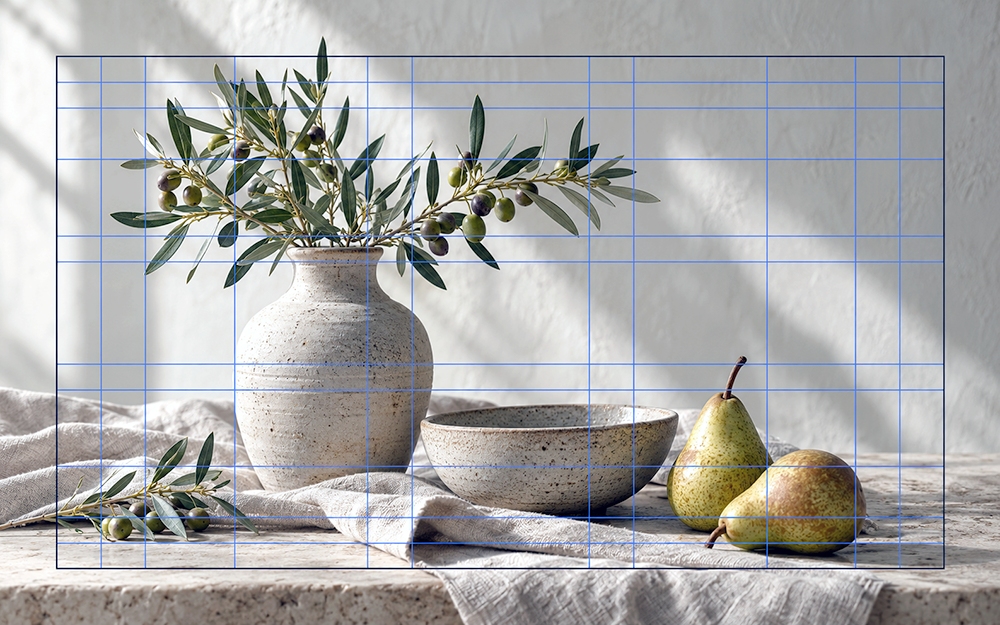
In still-life painting, the grid can help compare the space around a group of objects, assess the position of the principal vessel, and examine how secondary objects relate to the group’s overall shape. For example, move a tall vase away from the central band toward an inner division and observe whether the counterweight on the opposite side changes.
The aim is not to make the vase coincide perfectly with a line. Consider its cast-shadow mass, overlaps with other objects, folds in nearby fabric, and the shape of the remaining negative space. A small, saturated fruit may visually balance a larger, low-contrast vessel.
Landscape: horizon and repeated forms
In landscape painting, the horizontal guides allow the artist to compare several possible horizon positions and relationships between bands of land, sky, and atmosphere. Where trees or buildings repeat, the grid may help the artist examine their rhythm, although their spacing need not be artificially forced into the numerical sequence.
Perspective, atmospheric depth, irregular natural forms, and contrasts remain essential. A numerical division cannot replace these qualities.
Portrait and figure: placement, not anatomy
A portrait painter might use the grid to evaluate the space above the head, at the sides of the figure, or in the direction of a subject’s gaze. It may help examine the overall scale of the figure within the format. It is not a measurement system for human anatomy or facial proportions and does not prescribe where an eye, nose, or elbow belongs.
Abstract painting: unequal intervals
For an abstract composition, the unequal divisions can provide a deliberate starting experiment: one broad field, several narrow strips, and varied intervals between shapes. Nevertheless, visual balance will also depend on color, value, texture, and edge treatment, not just on measured widths.
Grid, squares, and spiral are different constructions
Fibonacci Grid is the subject of this article. It consists of straight lines whose positions follow an explicit calculation from selected sequence terms and their sum.
Fibonacci Squares are adjoining squares with side lengths such as 1, 1, 2, 3, 5, 8, 13, and so on. When arranged in a consistent sequence, they build an expanding rectangle.
Fibonacci Spiral usually refers to connected quarter-circle arcs drawn through such squares. The resulting piecewise-circular curve is not mathematically identical to the logarithmic golden spiral, although the constructions become increasingly similar as the terms grow [4, 5].
Phi Grid is a separate system of straight-line divisions based on the golden ratio. Some guides may appear visually similar, but their line coordinates are derived differently.
REGIS ARS provides the Fibonacci Grid, Fibonacci Squares, Fibonacci Spiral, and Fibonacci Spiral + Squares as distinct compositional guide options. They share mathematical context but serve different kinds of visual investigation.
What the history actually tells us
The sequence is now named after Leonardo of Pisa, known as Fibonacci. In his 1202 Liber abaci, a rabbit population problem produced this numerical recurrence. He was not, however, the first person known to investigate the sequence [2].
Earlier Indian mathematical and prosodic traditions examined the combinations of short and long syllables, producing the same numerical relationship. Historical scholarship discusses Virahanka, Gopala, and Hemachandra. A 1985 paper by historian of mathematics Parmanand Singh traces these contributions and their relationship to the later European account [3].
Nevertheless, the antiquity of the sequence does not establish that ancient or Renaissance painters used the specific symmetrical twenty-line grid discussed here. A claim of historical usage would require credible historical evidence. Coincidences observed by placing the overlay on an old painting are not sufficient.
Does the Fibonacci sequence guarantee beauty?
No. The mathematical properties of the sequence can be demonstrated, but a compositional preference is a separate empirical question. Neither the sequence nor the exact coordinates of this grid guarantee better art.
Even research comparing more closely related geometrical forms, such as golden and Fibonacci spirals, does not justify presenting them as a permanent and universal ideal of visual beauty [4]. Research on the preference for spiral shapes cannot be taken as direct evidence for the effectiveness of this straight-line grid.
For a working painter, the more useful question is whether the overlay reveals a relationship that was previously difficult to see. If it does, it has served its purpose. If it merely distracts or encourages arbitrary repositioning to match lines, turn it off.
Practical exercise: one subject, three arrangements
Set up a small still life with four objects, or use a landscape photograph as a reference for preliminary sketches. Produce three small studies with the same aspect ratio.
- Without guides. Organize the principal group, large value masses, focal point, and negative space.
- Using the Rule of Thirds. Explore an alternative focal position and a different balance among the major areas. Do not simply duplicate the first sketch.
- Using the Fibonacci Grid. Mark the divisions at 5, 10, 20, 35, 40, 60, 65, 80, 90, and 95 percent. Select only a few lines to address a specific issue, such as cramped margins or poorly balanced grouping.
Place the studies side by side and compare the focal emphasis, balance of light and dark masses, silhouette, and rhythm of edges and gaps. Note which arrangement works best and why. The third study does not have to win.
Conclusion
The Fibonacci Grid provides one possible way to investigate unequal compositional areas. The REGIS ARS version examined here uses the sum of six Fibonacci numbers to generate ten symmetrical vertical and ten horizontal divisions.
The grid can be useful for evaluating spacing, rhythm, and the distribution of visual areas. It is not a historically universal painting rule and should not be confused with Fibonacci squares or the spiral. Like any compositional guide, its value lies in helping the artist make deliberate visual decisions.
Sources and further reading
[1] Weisstein, Eric W. Fibonacci Number. Wolfram MathWorld. Definition of the sequence and its relationship to the golden ratio.
[2] O’Connor, J. J., Robertson, E. F. Fibonacci. MacTutor History of Mathematics, University of St Andrews. Biography and the historical context of the 1202 Liber abaci.
[3] Singh, Parmanand. The so-called Fibonacci numbers in ancient and medieval India. Historia Mathematica 12(3), 229–244 (1985). DOI: 10.1016/0315-0860(85)90021-7.
[4] Hübner, Ronald. Golden spiral or Fibonacci spiral: Which is more beautiful and why? i-Perception (2024). A study of aesthetic responses to spiral shapes, not proof of the grid’s usefulness.
[5] On the Construction of 3D Fibonacci Spirals*. Mathematics 12(2), 201 (2024). Discusses the classical square-and-quarter-circle construction.