

Fibonacci Squares
From Number Sequence to Composition
Fibonacci squares are a geometric construction in which squares are joined edge to edge, with side lengths following the Fibonacci sequence. As the arrangement grows, it forms rectangles whose aspect ratios approach the golden ratio. The construction offers a way to study changes in scale, relationships between differently sized areas, and visual rhythm [1, 2].
For an artist, this is first and foremost a tool for analysis and experimentation, not a rule requiring every subject to fit inside a prescribed square. The geometry can be calculated precisely. Its value in painting depends on the actual shapes, value relationships, colors, and artistic intention.
The mathematical foundation
The Fibonacci sequence can be written as:
1, 1, 2, 3, 5, 8, 13, 21, 34, …
Beginning with the third term, each number is the sum of the preceding two: 1 + 1 = 2, 1 + 2 = 3, and 2 + 3 = 5. A square with a side equal to the next number can therefore be attached along the longer side of the rectangle formed in the previous stage [1].
Remember that each Fibonacci number specifies the side length, not the area, of its square. A square with side length 8 units has an area of 64 square units. This helps explain why the largest squares quickly dominate the arrangement.
Building the sequence of squares
Start with two adjacent 1 × 1 squares. Together they form a 2 × 1 rectangle. Add a 2 × 2 square along the longer side to form a 3 × 2 rectangle. Continue by attaching squares with sides 3, 5, 8, and 13 units. Each new square is placed against the longer side of the entire rectangle built so far, rotating the attachment direction around the existing structure [1, 2].
The construction may grow clockwise or counterclockwise. It can also be rotated or mirrored without changing its mathematical principle. Such variations differ in orientation, not in the underlying Fibonacci relationship.
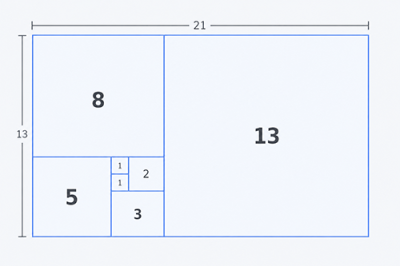
The seven side lengths are:
1 · 1 · 2 · 3 · 5 · 8 · 13
These seven squares fit together without gaps or overlaps to fill a 13 × 21 unit rectangle (or 21 × 13 when the design is rotated). Their combined area is:
1² + 1² + 2² + 3² + 5² + 8² + 13² = 273 = 13 × 21
This is not a coincidence. The general identity states that the sum of the squares of the first n Fibonacci numbers equals the product of the nth and the following Fibonacci number: F₁² + … + Fₙ² = Fₙ × Fₙ₊₁ [2, 3].
Why the golden ratio appears
Ratios of consecutive Fibonacci numbers converge toward φ = (1 + √5)/2 ≈ 1.618034. Consequently, the rectangles produced by the square arrangement progressively approach the aspect ratio of a golden rectangle [1, 4].
Compare several ratios:
- 5/3 ≈ 1.6667
- 8/5 = 1.6
- 13/8 = 1.625
- 21/13 ≈ 1.6154
- φ ≈ 1.6180
The ratios alternate above and below φ. No finite ratio of two consecutive Fibonacci numbers equals φ exactly. A rectangle measuring 13 × 21 units is therefore an approximation to a golden rectangle, not a mathematically exact golden rectangle.
A true golden rectangle can be subdivided into a square and a smaller similar rectangle, repeatedly. The Fibonacci-square construction usually works in the opposite direction: from the smallest squares toward successively larger ones. These two processes are related, but they should not be conflated [4].
The construction used in REGIS ARS
The REGIS ARS composition guide Fibonacci Squares uses exactly seven squares with sides 1, 1, 2, 3, 5, 8, and 13. They are added in the following repeating directions: right, down, left, up. In its initial orientation, the combined shape is 13 units wide and 21 units high.
To fit the guide into the selected canvas, the arrangement is scaled proportionally to a maximum of 95% of the available dimensions and centered. The squares are not stretched. Their sides remain equal, so the amount of empty space surrounding the guide can vary with the canvas format.
For example, on a 60 × 40 cm landscape canvas, the unrotated 13 × 21 construction occupies approximately 23.52 × 38 cm. This leaves substantial unused space to the sides. The difference is not a geometric error. It results from placing a relatively tall construction inside a wide picture. If a more extensive fit is needed, consider rotating the construction or choosing a different picture format rather than distorting the squares.
This is a particular implementation of the Fibonacci-square arrangement, not a universally mandatory version of the construction. Other examples may use more squares or a different starting orientation.
Squares, spiral, and combined construction
Square outlines and a spiral are not identical. Fibonacci squares reveal the hierarchy of areas, straight boundaries, rectangles, and turns of the construction. A Fibonacci spiral is commonly drawn by placing a quarter-circle arc inside each square, using a radius equal to its side length. Connecting the arcs produces a curve with a spiral-like progression [5, 6].
Each arc is part of a circle. Its curvature is constant within that arc but changes when the drawing passes to the next arc. The resulting curve is not an exact logarithmic golden spiral, whose radius increases according to a continuous logarithmic relationship. The Fibonacci spiral is a geometric approximation [5, 6].
A combined guide can display both the square outlines and the arcs. The squares explain the construction, while the arcs emphasize directional flow. The spiral itself deserves a separate article covering the mathematics of the curve and its practical interpretation in painting.
History, evidence, and popular myths
Leonardo of Pisa, commonly known as Fibonacci, discussed the number sequence in his 1202 book Liber abaci, including the well-known hypothetical rabbit-population problem [7]. However, the sequence’s rule was discussed earlier within Indian mathematical traditions. The contributions of Virahanka, Gopala, and Hemachandra are documented in a historical study by Parmanand Singh [8].
This is evidence for the history of the sequence, not evidence that medieval or Renaissance painters routinely organized pictures using the modern seven-square diagram. Such a claim would require specific historical documents or reliable technical studies of artworks.
Similarly, an apparent match between a square construction or spiral and a shell, plant, or famous painting does not prove intentional use. Natural growth occurs in many forms, and an overlay can be repositioned or cropped in numerous ways. A mathematical possibility must be distinguished from documented artistic practice [5].
Practical uses in painting
Still life: a hierarchy of sizes
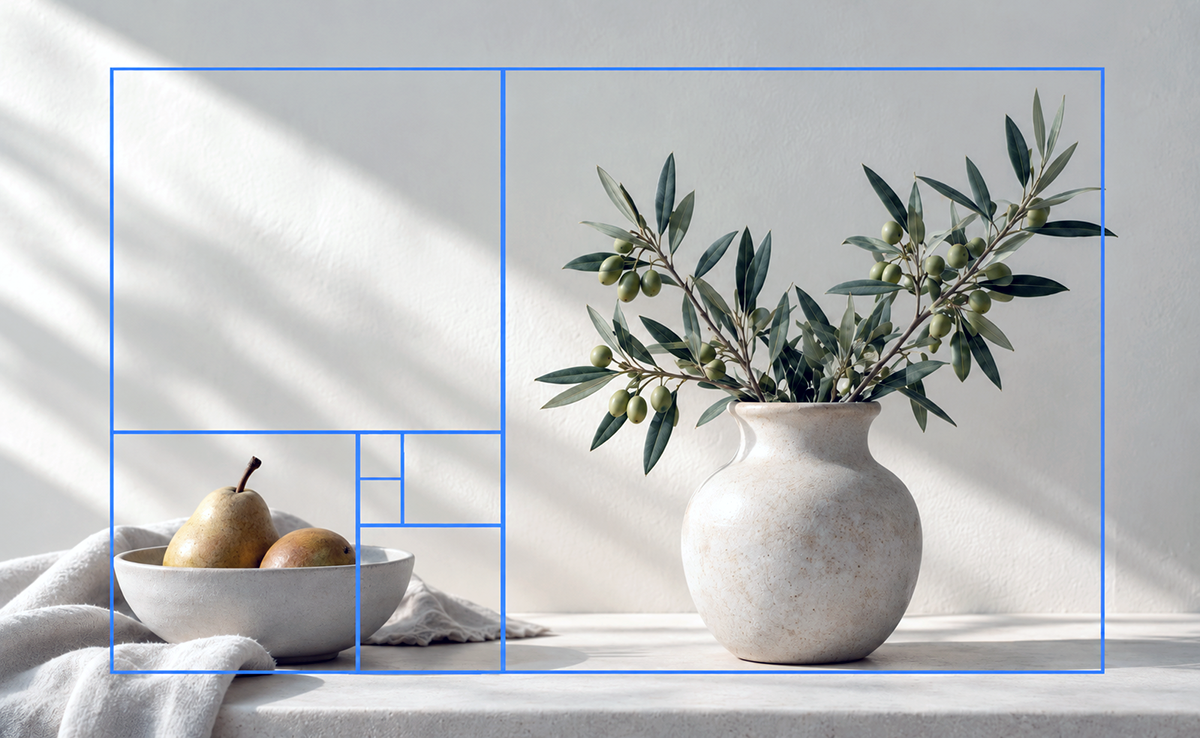
In a still life, differently sized squares can serve as reference regions for comparing the principal silhouette, a taller vessel, smaller objects, and surrounding negative space. For example, the largest region might suggest where to organize a major light mass, while the smaller regions can help explore secondary contrasts.
This does not mean a particular piece of fruit must fit neatly inside a 3 × 3 region or that a vase must be confined to a 5 × 5 square. Overlaps, cast shadows, and visual weight may be far more important than geometric alignment.
Landscape: changing scale and rhythm
In landscape painting, the progression from small to large squares can inspire comparisons between major and minor visual elements: a broad cloud bank, a distant line of trees, and a few small foreground accents. Yet convincing pictorial space still depends primarily on perspective, atmospheric depth, light, and value contrasts.
Fibonacci squares do not prescribe the horizon or perspective vanishing points. They are neither a perspective grid nor a system for measuring natural forms.
Portrait and figure: the overall format
In portraiture, the construction can help explore the figure’s relationship to the background, the overall silhouette, or the distribution of surrounding areas. It is not a rule for human anatomical proportions. No Fibonacci number dictates the correct location of an individual person’s eye, nose, or hand.
Abstraction and graphic composition
In abstract painting, the squares can themselves become structural material: fields of different sizes, repeated changes of scale, direction changes, and relationships between adjacent areas. Deliberate departures from the grid may be equally important when a strict geometric pattern makes the result predictable or rigid.
When the construction is less useful
The growing squares establish a strong hierarchy but may draw too much attention toward the largest region or the cluster of smallest ones. Their rectangular logic may conflict with an irregular, organic subject. Moreover, when the canvas aspect ratio and the construction’s ratio differ greatly, the overlay may occupy only part of the available space.
Avoid forcing the picture to fit the grid. First consider the major value masses, silhouette, character of edges, and intended movement of the viewer’s eye. Mathematical order alone cannot supply meaning or pictorial expression.
Practical exercise: three compositional studies
- Construct the squares. On graph paper, draw the seven squares with sides 1, 1, 2, 3, 5, 8, and 13 cells. Check that they form a 13 × 21 rectangle. Then rotate the arrangement by 90 degrees and compare its appearance.
- Make three still-life thumbnails. Begin without a guide. In the second thumbnail, use the square boundaries to explore relationships between differently sized parts of the subject group. In the third, rotate or mirror the arrangement and deliberately change the compositional emphasis.
- Evaluate the image, not the arithmetic. Compare the hierarchy of major and minor shapes, negative spaces, and whether the subject’s natural silhouette has been compromised by the overlay. If the unguided study is stronger, that is an equally valuable result.
Conclusion
Fibonacci squares provide a mathematically consistent way to explore increasing scales and the relationships between them. Seven squares create a 13 × 21 rectangle with proportions close to, but not exactly equal to, the golden ratio.
For painters, the construction is most useful as a means of comparison, exploration, and experimentation. It may suggest an organization, but it cannot make an artistic decision for the artist.
Sources and further reading
[1] Beardon, Toni. Whirling Fibonacci Squares. NRICH, University of Cambridge, 2011.
[2] Approximation to Golden Rectangle using Fibonacci Squares. ProofWiki.
[3] Nagy, M., Cowell, S. R., Beiu, V. On the Construction of 3D Fibonacci Spirals. Mathematics, 12(2), 201 (2024).
[4] Weisstein, Eric W. Golden Rectangle. Wolfram MathWorld.
[5] Hart, Sarah. The Maths of Proportion in Art, Design and Nature. Gresham College, 2022.
[6] Hübner, Ronald. Golden spiral or Fibonacci spiral: Which is more beautiful and why? i-Perception, 15(2) (2024).
[7] O’Connor, J. J., Robertson, E. F. Leonardo Pisano Fibonacci. MacTutor History of Mathematics, University of St Andrews.
[8] Singh, Parmanand. The so-called fibonacci numbers in ancient and medieval India. Historia Mathematica, 12(3), 229–244 (1985).